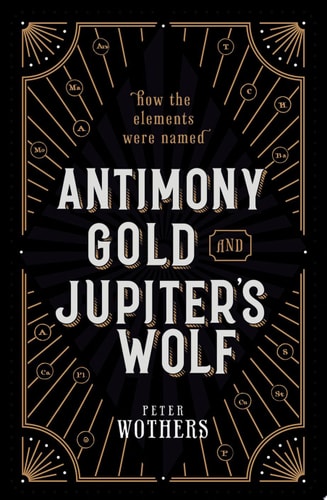
Antimony, Gold, and Jupiter's Wolf
0
0
As an Amazon Associate and affiliate partner, Menrva Books earns from qualifying purchases. Learn more
Author Description
The iconic periodic table of the elements is now in its most satisfyingly elegant form. This is because all the 'gaps' corresponding to missing elements in the seventh row, or period, have recently been filled and the elements named. But where do these names come from? For some, usually the most recent, the origins are quite obvious, but in others - even well-known elements such as oxygen or nitrogen - the roots are less clear. Here, Peter Wothers explores the fascinating and often surprising stories behind how the chemical elements received their names. Delving back in time to explore the history and gradual development of chemistry, he sifts through medieval manuscripts for clues to the stories surrounding the discovery of the elements, showing how they were first encountered or created, and how they were used in everyday lives. As he reveals, the oldest-known elements were often associated with astronomical bodies, and connections with the heavens influenced the naming of a number of elements. Following this, a number of elements, including hydrogen and oxygen, were named during the great reform of chemistry, set amidst the French Revolution. While some of the origins of the names were controversial (and indeed incorrect - some saying, for instance, that oxygen might be literally taken to mean 'the son of a vinegar merchant'), they have nonetheless influenced language used around the world to this very day. Throughout, Wothers delights in dusting off the original sources, and bringing to light the astonishing, the unusual, and the downright weird origins behind the names of the elements so familiar to us today.
Menrva's Summary
THE THESIS
This book investigates the etymological origins and historical contexts behind the naming of the chemical elements. Peter Wothers, a chemist and educator, utilizes historical manuscripts and scientific records to trace how elements were identified and named from antiquity to the modern era. He argues that the nomenclature of chemistry is not merely a technical classification system but a reflection of cultural, astronomical, and political shifts throughout human history.
THE SCOPE MAP
What You Will Find
- Historical analysis of element naming conventions from ancient times to the present
- Examination of the influence of astronomy and mythology on early chemical terminology
- Documentation of the Great Reform of Chemistry during the French Revolution
- Insights into medieval alchemical texts and their role in element discovery
Scope Limits
- The text does not provide a comprehensive technical manual for modern laboratory chemical synthesis
- It focuses primarily on the history of names rather than the complete physical properties of every element
THE AUTHORITY PERSPECTIVE
Experts and readers frequently note the accessibility of the prose despite the academic subject matter. The text is widely regarded as a valuable resource for those interested in the intersection of linguistics and the history of science.
Page Count:
352
Publication Date:
2019-01-01
Publisher:
Oxford University Press
ISBN-10:
0192569899
ISBN-13:
9780192569899
Science
Non-Fiction
Science History
Chemistry
Etymology
Community Tags
Similar Books