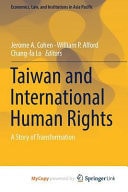
Taiwan and International Human Rights: A Story of Transformation
0
0
As an Amazon Associate and affiliate partner, Menrva Books earns from qualifying purchases. Learn more
Author Description
This book tells a story of Taiwan's transformation from an authoritarian regime to a democratic system where human rights are protected as required by international human rights treaties. There were difficult times for human rights protection during the martial law era; however, there has also been remarkable transformation progress in human rights protection thereafter. The book reflects the transformation in Taiwan and elaborates whether or not it is facilitated or hampered by its Confucian tradition. There are a number of institutional arrangements, including the Constitutional Court, the Control Yuan, and the yet-to-be-created National Human Rights Commission, which could play or have already played certain key roles in human rights protections. Taiwan's voluntarily acceptance of human rights treaties through its implementation legislation and through the Constitutional Court's introduction of such treaties into its constitutional interpretation are also fully expounded in the book. Taiwan's NGOs are very active and have played critical roles in enhancing human rights practices. In the areas of civil and political rights, difficult human rights issues concerning the death penalty remain unresolved. But regarding the rights and freedoms in the spheres of personal liberty, expression, privacy, and fair trial (including lay participation in criminal trials), there are in-depth discussions on the respective developments in Taiwan that readers will find interesting. In the areas of economic, social, and cultural rights, the focuses of the book are on the achievements as well as the problems in the realization of the rights to health, a clean environment, adequate housing, and food. The protections of vulnerable groups, including indigenous people, women, LGBT (lesbian, gay, bisexual, and transgender) individuals, the disabled, and foreigners in Taiwan, are also the areas where Taiwan has made recognizable achievements, but still encounters problems. The comprehensive
Menrva's Summary
THE THESIS
This book chronicles Taiwan's significant journey from an authoritarian state to a democratic society with a focus on the evolution of human rights protection. The narrative details the challenges faced during the martial law era and the subsequent progress made, examining the influence of Confucian tradition on these developments. It explores the roles of key institutions like the Constitutional Court and the proposed National Human Rights Commission in safeguarding rights, alongside Taiwan's voluntary adoption of international human rights treaties. The book also highlights the crucial contributions of NGOs and delves into specific areas of civil, political, economic, social, and cultural rights, as well as the protections afforded to vulnerable groups.
THE SCOPE MAP
- Analysis of Taiwan's transition from authoritarianism to democracy with an emphasis on human rights.
- Examination of the impact of Confucian tradition on human rights protection.
- Discussion of institutional arrangements for human rights, including the Constitutional Court, Control Yuan, and National Human Rights Commission.
- Exploration of Taiwan's voluntary acceptance and implementation of international human rights treaties.
- In-depth look at the roles and achievements of Non-Governmental Organizations (NGOs) in human rights advocacy.
- Detailed discussion on civil and political rights, including the unresolved issue of the death penalty and developments in personal liberty, expression, privacy, and fair trial.
- Analysis of economic, social, and cultural rights, focusing on achievements and challenges in realizing rights to health, a clean environment, adequate housing, and food.
- Assessment of protections for vulnerable groups such as indigenous people, women, LGBT individuals, the disabled, and foreigners.
THE AUTHORITY PERSPECTIVE
This book is likely to be regarded as a comprehensive and authoritative account of Taiwan's human rights development, drawing on legal, political, and historical perspectives. The detailed examination of institutional frameworks, treaty implementation, and the roles of civil society suggests a text valuable for scholars and policymakers interested in Taiwan's democratization and human rights landscape. The multi-faceted approach, covering various rights and vulnerable groups, indicates a thorough exploration of the subject matter. The inclusion of unresolved issues like the death penalty alongside progress in other areas points to a balanced and nuanced perspective.
Page Count:
706
Publication Date:
2019-01-01
Publisher:
Springer Singapore
ISBN-10:
9811303517
ISBN-13:
9789811303517
Politics
Non-Fiction
History
Law
Asian Studies
Human rights
Taiwan
Community Tags
Similar Books






Reader Comments
Share Your Thoughts
No comments yet. Be the first to share your thoughts!