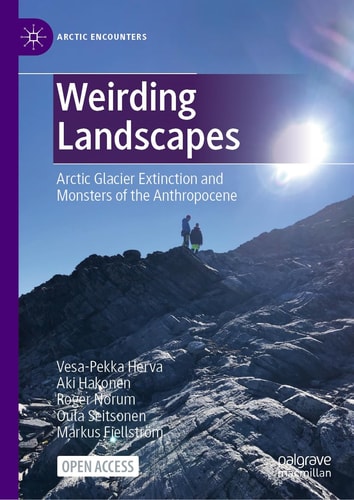
Weirding Landscapes: Arctic Glacier Extinction and Monsters of the Anthropocene
0
0
As an Amazon Associate and affiliate partner, Menrva Books earns from qualifying purchases. Learn more
Author Description
This open access book investigates human-environment relations in the context of the anthropocenic Arctic. Through an archaeological and anthropological study of landscape, it wields “weirding” – a creative mode of engagement with the world – as a means of coming to terms with the stranger, experiential dimensions of a planet populated by diverse non-human entities often bearing monstrous characteristics. Such entities are exemplified by climate change itself, at once human-induced and a force of its own volition that maintains an elusive “presence” as a co-inhabitant of the Anthropocene. The book focuses on the landscape of Ritničohkka, a fjell in Sápmi, Finnish Lapland. Ritničohkka is erstwhile home to a diminutive “glacier”, whose “weird”, anomalous characteristics crowned the fjell until it several years ago melted into history. Taking a broadly autoethnographic approach, it considers perceptions of, and affective experiences in, this rough and relatively remote, “otherworldly” environment, discussing diverse ways of encountering and relating to the Arctic in the context of scientific fieldwork.
Menrva's Summary
THE THESIS
This book investigates the complex relationship between humans and the environment in the Anthropocene Arctic, using archaeological and anthropological methods to explore the experiential dimensions of a planet inhabited by diverse, often monstrous, non-human entities. The authors employ a creative mode of engagement called “weirding” to understand these entities, including climate change itself, which acts as both a human-induced force and an independent presence. The study centers on Ritničohkka, a mountain in Finnish Lapland that was once home to an anomalous glacier that has since melted. Through a broadly autoethnographic approach, the book examines perceptions and affective experiences within this remote, otherworldly environment, reflecting on various ways of encountering the Arctic during scientific fieldwork.
THE SCOPE MAP
- An archaeological and anthropological study of human-environment relations in the Arctic.
- Exploration of "weirding" as a mode of engaging with non-human entities and climate change.
- Focus on the landscape of Ritničohkka in Sápmi, Finnish Lapland, and its vanished glacier.
- Autoethnographic accounts of perceptions and affective experiences during scientific fieldwork.
- Analysis of the stranger, experiential dimensions of the Anthropocene Arctic.
- Consideration of climate change as a monstrous, co-inhabiting presence.
THE AUTHORITY PERSPECTIVE
The book's approach, combining archaeological and anthropological methods with a concept of "weirding" to explore human-environment relations in the Arctic, suggests a unique perspective on the Anthropocene. The focus on experiential dimensions and non-human entities, including climate change, points to a text that engages with complex ecological and philosophical themes. The use of autoethnography and fieldwork narratives indicates a potentially intimate and reflective exploration of the Arctic landscape. This work appears positioned to offer a nuanced understanding of how humans perceive and interact with a rapidly changing planet.
Page Count:
200
Publication Date:
2025-03-29
Publisher:
Springer Nature Switzerland
ISBN-10:
3031850157
ISBN-13:
9783031850158
Science
Non-Fiction
History
Arctic Studies
Archaeology
Anthropology
Community Tags
Similar Books