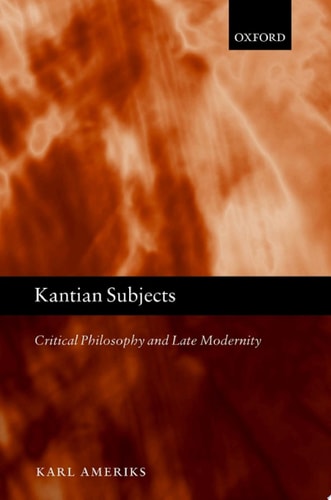
Kantian Subjects: Critical Philosophy and Late Modernity
0
0
As an Amazon Associate and affiliate partner, Menrva Books earns from qualifying purchases. Learn more
Author Description
In this volume, Karl Ameriks explores 'Kantian subjects' in three senses. In Part I, he first clarifies the most distinctive features-such as freedom and autonomy-of Kant's notion of what it is for us to be a subject. Other chapters then consider related 'subjects' that are basic topics in other parts of Kant's philosophy, such as his notions of necessity and history. Part II examines the ways in which many of us, as 'late modern,' have been highly influenced by Kant's philosophy and its indirect effect on our self-conception through successive generations of post-Kantians, such as Hegel and Schelling, and early Romantic writers such as Hölderlin, Schlegel, and Novalis, thus making us 'Kantian subjects' in a new historical sense. By defending the fundamentals of Kant's ethics in reaction to some of the latest scholarship in the opening chapters, Ameriks offers an extensive argument that Hölderlin expresses a valuable philosophical position that is much closer to Kant than has generally been recognized. He also argues that it was necessary for Kant's position to be supplemented by the new conception, introduced by the post-Kantians, of philosophy as fundamentally historical, and that this conception has had a growing influence on the most interesting strands of Anglophone as well as Continental philosophy.
Menrva's Summary
THE THESIS
This volume investigates the multifaceted definition of the 'Kantian subject' by examining both the core tenets of Immanuel Kant's philosophy and the historical evolution of his influence on late modern thought. Karl Ameriks, a scholar of German philosophy, utilizes a rigorous analytical framework to bridge the gap between Kant's original ethical and metaphysical propositions and their subsequent interpretations by post-Kantian thinkers. The text argues that understanding our contemporary self-conception requires acknowledging both the foundational autonomy Kant proposed and the historical necessity introduced by his successors.
THE SCOPE MAP
What You Will Find
- Analysis of Kantian concepts including freedom, autonomy, necessity, and history.
- Comparative studies of post-Kantian figures such as Hegel, Schelling, Hölderlin, Schlegel, and Novalis.
- A defense of Kantian ethics against contemporary scholarly critiques.
- Exploration of the historical turn in philosophy and its impact on Anglophone and Continental traditions.
Scope Limits
- The text does not provide a comprehensive biography of Kant or a general introduction to all of his works.
- It does not cover the entirety of 20th-century analytic philosophy, focusing primarily on the lineage of German Idealism and Romanticism.
THE AUTHORITY PERSPECTIVE
Scholars frequently cite this work as a significant contribution to the study of German Idealism, noting its precise handling of the transition from Kantian ethics to Romantic philosophy. Experts highlight the text as a dense, scholarly resource that is best suited for readers with a strong background in the history of modern philosophy.
Page Count:
284
Publication Date:
2019-01-01
Publisher:
OUP Oxford
ISBN-10:
0192578987
ISBN-13:
9780192578983
Philosophy
Modern Philosophy
Philosophy history
Kant
Ethics
Community Tags
Similar Books