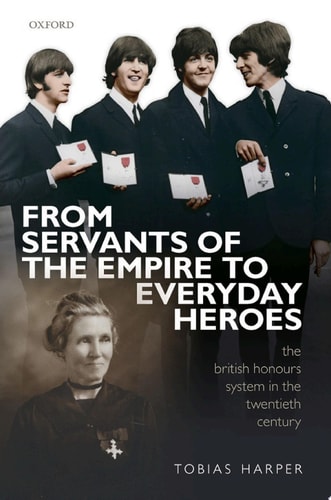
From Servants of the Empire to Everyday Heroes: The British Honours System in the Twentieth Century
0
0
As an Amazon Associate and affiliate partner, Menrva Books earns from qualifying purchases. Learn more
Author Description
In the twentieth century, the British Crown appointed around a hundred thousand people - military and civilian - in Britain and the British Empire to honours and titles. For outsiders, and sometimes recipients too, these jumbles of letters are tantalizingly confusing: OM, MBE, GCVO, CH, KB, or CBE. Throughout the century, this system expanded to include different kinds of people, while also shrinking in its imperial scope with the declining empire. Through these dual processes, this profoundly hierarchical system underwent a seemingly counter-intuitive change: it democratized. Why and how did the British government change this system? And how did its various publics respond to it? This study addresses these questions directly by looking at the history of the honours system in the wider context of the major historical changes in Britain and the British Empire in the twentieth century. In particular, it looks at the evolution of this hierarchical, deferential system amidst democratization and decolonization. It focuses on the system's largest-and most important-components: the Order of the British Empire, the Knight Bachelor, and the lower ranks of other Orders. By creatively analysing the politics and administration of the system alongside popular responses to it in diaries, letters, newspapers, and memoirs, Tobias Harper shows the many different meanings that honours took on for the establishment, dissidents, and recipients. He also shows the ways in which the system succeeded and failed to order and bring together divided societies.
Menrva's Summary
THE THESIS
How did the British honours system evolve from an instrument of imperial hierarchy into a mechanism of democratization during the twentieth century? Author Tobias Harper examines the administrative and political shifts within the British honours system, analyzing how the state utilized titles to manage social cohesion amidst the decline of the British Empire. By synthesizing archival records with personal accounts, Harper argues that the system's expansion and diversification reflect broader societal changes in Britain, including the transition from imperial deference to modern democratic participation.
THE SCOPE MAP
What You Will Find
- Analysis of the Order of the British Empire, the Knight Bachelor, and lower-ranking honours.
- Examination of the intersection between state administration and public perception.
- Historical context regarding decolonization and the democratization of British society.
Scope Limits
- The study focuses primarily on the twentieth century and does not provide an exhaustive history of the honours system prior to 1900.
- The research emphasizes the largest components of the system rather than every minor or obscure order.
THE AUTHORITY PERSPECTIVE
Scholars and historians recognize this work as a comprehensive study of the administrative and social mechanics behind British state recognition. Readers frequently note the academic density of the prose, which provides a rigorous examination of how institutional structures adapt to shifting political landscapes.
Page Count:
288
Publication Date:
2020-01-01
Publisher:
OUP Oxford
ISBN-10:
019257809X
ISBN-13:
9780192578099
History
Sociology
British History
Orders of knighthood and chivalry--History
20th Century
Decorations of honor
Imperial History
Modern History
Community Tags
Similar Books