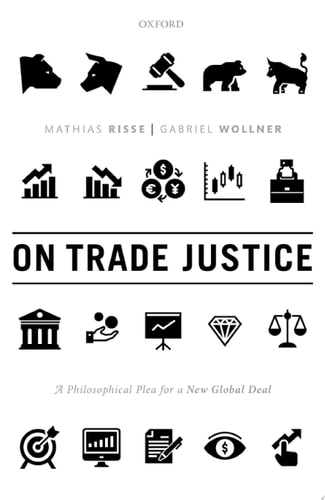
On Trade Justice: A Philosophical Plea for a New Global Deal
0
0
As an Amazon Associate and affiliate partner, Menrva Books earns from qualifying purchases. Learn more
Author Description
Trade has made the world. Still, trade remains an elusive and profoundly difficult area for philosophical thought. This novel account of trade justice makes ideas about exploitation central, giving pride of place to philosophical ideas about global justice but also contributing to moral disputes about practical questions. On Trade Justice is a philosophical plea for a new global deal, in continuation of, but also at appropriate distance to, post-war efforts to design a fair global-governance system in the spirit of the American New Deal of the 1930s. This book is written in the tradition of contemporary analytical philosophy but also puts its subject into a historical perspective to motivate its relevance. It covers the subject of trade justice from its theoretical foundations to a number of specific issues on which the authors' account throws light. The state as an actor in the domain of global justice is central to the discussion but it also explores the obligations of business extensively, recognizing the importance of the modern corporation for trade. Topics such as wages injustice, collusion with authoritarian regimes, relocation decisions, and obligations arising from interaction with suppliers and sub-contractors all enter prominently. Another central actor in the domain of trade is the World Trade Organization. The WTO needs to see itself as an agent of justice. This book explores how this organization should be reformed in light of the proposals it makes. In particular, the WTO needs to endorse a human-rights and development-oriented mandate. Overall, this book hopes to make a theoretical contribution to the creation of an exploitation-free world.
Menrva's Summary
THE THESIS
This book investigates the moral foundations of international trade and argues for a new global deal centered on the elimination of exploitation. Authors Gabriel Wollner and Mathias Risse utilize the framework of contemporary analytical philosophy to evaluate the fairness of global governance systems. They bridge the gap between abstract moral theory and practical policy, proposing that institutions like the World Trade Organization must adopt a human-rights and development-oriented mandate to address systemic injustices.
THE SCOPE MAP
What You Will Find
- A theoretical framework for identifying exploitation in global trade networks
- Analysis of the moral obligations of states and multinational corporations
- Proposals for reforming the World Trade Organization
- Ethical evaluation of wage structures, supply chain management, and corporate relocation
Scope Limits
- Does not provide a comprehensive history of all post-war trade agreements
- Does not offer a detailed technical manual for specific trade policy implementation
THE AUTHORITY PERSPECTIVE
Experts recognize this work as a significant contribution to the intersection of political philosophy and international political economy. Readers frequently note the academic density of the prose, which is well-suited for scholars and students interested in the normative dimensions of global trade governance.
Page Count:
288
Publication Date:
2019-01-01
Publisher:
OUP Oxford
ISBN-10:
019257437X
ISBN-13:
9780192574374
Economics
Philosophy
International relations
Global Justice
Ethics
Community Tags
Similar Books