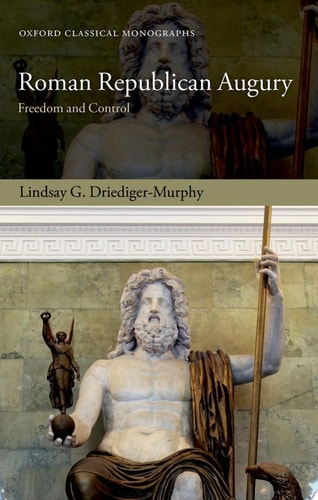
Roman Republican Augury: Freedom and Control
0
0
As an Amazon Associate and affiliate partner, Menrva Books earns from qualifying purchases. Learn more
Author Description
Roman Republican Augury: Freedom And Control Proposes A New Way Of Understanding Augury, A Form Of Roman State Divination Designed To Consult The God Jupiter. Previous Scholarly Studies Of Augury Have Tended To Focus Either Upon Its Legal-constitutional Aspects (especially Its Place In Defining, Structuring, And Circumscribing The Precise Constitutional Powers Of Magistrates), Or Upon Its Role In Maintaining And Perpetuating Roman Social And Political Structures (primarily As A Tool Of The Elite). This Volume Makes A New And Original Contribution To The Study Of Roman Religion, Theology, Politics, And Cultural History By Challenging The Prevailing View That Official Divination Was Organized To Produce Only The Results Its Users Wanted, And Focusing Instead Upon What It Can Tell Us About How The Romans Understood Their Relationship With Their Gods. Rather Than Supposing That Augury, Like Other Forms Of Roman Public Divination, Told Romans What They Wanted To Hear, It Argues That Augury In Both Theory And Practice Left Space For Perceived Expressions Of Divine Will Which Contradicted Human Wishes, And That Its Rules And Precepts Did Not Allow Human Beings Simply To Create Or Ignore Signs At Will. Analysis Of The Historical Evidence For Romans Receiving, And Heeding, Signs Which Would Seem To Have Conflicted With Their Own Desires Allows The Jupiter Whom They Approached In Augury To Emerge As Not Simply A Source Of Power To Be Tapped And Channelled To Human Ends, But As A Person With His Own Interests And Desires, Which Did Not Always Overlap With Those Of His Human Enquirers. When Human And Divine Will Clashed, It Was The Will Of Jupiter, Not That Of The Man Consulting Him, Which Was Supposed To Prevail. In Theory As In Practice, It Was The Romans, Not Their Supreme God, Who Were 'bound' By The Auguries And Auspices.
Menrva's Summary
THE THESIS
This volume investigates the theological and political function of Roman Republican augury, specifically questioning whether the practice served merely as a tool for elite control or as a genuine mechanism for interpreting the will of Jupiter. Author Lindsay G. Driediger-Murphy challenges the prevailing scholarly consensus that Roman state divination was a purely manipulative instrument designed to validate human political agendas. By examining historical evidence where augural signs contradicted the desires of magistrates, the author argues that the Roman religious framework acknowledged Jupiter as an autonomous deity with interests distinct from those of his human enquirers. The work posits that the rules of augury functioned to bind human actors to divine will rather than allowing them to dictate it.
THE SCOPE MAP
What You Will Find
- Analysis of the legal and constitutional frameworks governing Roman augury.
- Examination of historical case studies where augural signs conflicted with human political objectives.
- A theological reassessment of the relationship between Roman magistrates and the god Jupiter.
Scope Limits
- The study focuses primarily on the Republican period and does not extend into the Imperial transformation of these religious rites.
- The analysis does not cover private or non-state forms of divination.
THE AUTHORITY PERSPECTIVE
Scholars recognize this work as a significant intervention in the study of Roman religion, particularly for its shift away from purely functionalist interpretations of divination. Readers frequently note the academic density of the prose, which is intended for specialists in classical history and theology.
Page Count:
344
Publication Date:
2019-01-01
Publisher:
Oxford University Press
ISBN-10:
0192571273
ISBN-13:
9780192571274
History
Ancient History
Roman Religion
Divination
Theology
Community Tags
Other Editions(2)
Similar Books











Reader Comments
Share Your Thoughts
No comments yet. Be the first to share your thoughts!