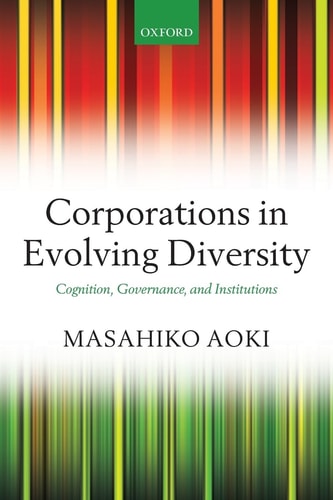
Corporations in Evolving Diversity: Cognition, Governance, and Institutions
0
0
As an Amazon Associate and affiliate partner, Menrva Books earns from qualifying purchases. Learn more
Author Description
In this classic text, Masahiko Aoki explores how the 2008-9 financial crisis demanded a re-examination of the role of corporations and the working of financial markets around the world, providing a compelling new analysis of the corporate firm; the role of shareholders, managers and workers; and institutional governance structures.In recent decades the firm has predominantly been seen as an organization run and governed in the interests of shareholders, where management act as the agent of shareholders, and the workers simply as instruments for share-value maximization. This book reverses this viewpoint. It sees corporations as associational cognitive systems where 'cognitive actions' are distributed amongst managers and workers, with shareholders supplying 'cognitive tools' and monitoring their use in the systems. Aoki analyses the different relationships that can exist between shareholders, managers, and workers from this perspective, and identifies a range of different models of organizational architecture and associated governance structures. He also discusses ways in which corporations act as players in social, political, and organizational games, as well as global economic games; how these inter-related social dynamics may change particular distinctive national structures into the diversity incorporated in the global corporate landscape; and how they now call for new roles for financial markets.
Menrva's Summary
THE THESIS
This book investigates how the 2008-9 financial crisis necessitates a fundamental shift in our understanding of the corporation from a shareholder-centric model to an associational cognitive system. Masahiko Aoki, a prominent economist, utilizes institutional analysis to challenge the traditional view of the firm as a mere instrument for share-value maximization. By framing corporations as systems where cognitive actions are distributed among managers and workers, he provides a framework for understanding how organizational architecture and governance structures interact with global financial markets.
THE SCOPE MAP
What You Will Find
- Analysis of the 2008-9 financial crisis as a catalyst for institutional reform.
- A theoretical framework defining the firm as an associational cognitive system.
- Comparative study of relationships between shareholders, managers, and workers.
- Examination of how national structures influence global corporate diversity.
THE AUTHORITY PERSPECTIVE
Experts recognize this work as a significant contribution to the field of institutional economics and corporate governance. Readers frequently note the academic density of the prose, which provides a rigorous analytical foundation for understanding modern organizational dynamics.
Page Count:
232
Publication Date:
2019-06-04
Publisher:
Oxford University Press
ISBN-10:
0198835299
ISBN-13:
9780198835295
Economics
Organizational effectiveness
Finance
Business Ethics
Corporate governance
Management
Community Tags
Similar Books