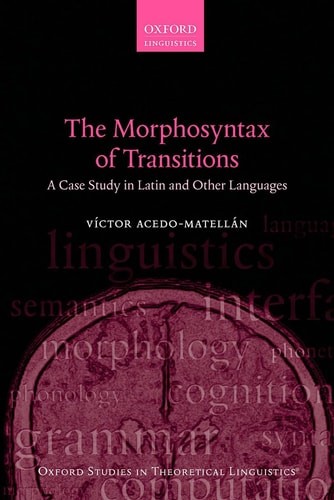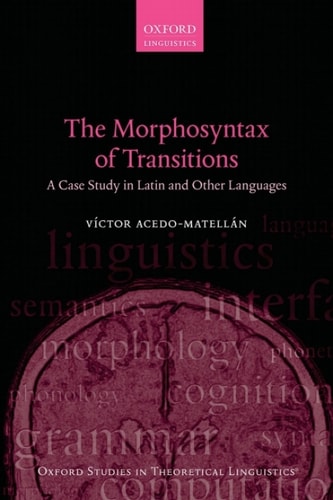
The Morphosyntax of Transitions: A Case Study in Latin and Other Languages
0
0
As an Amazon Associate and affiliate partner, Menrva Books earns from qualifying purchases. Learn more
Author Description
This book examines the cross-linguistic expression of changes of location or state, taking as a starting point Talmy's typological generalization that classifies languages as either 'satellite-framed' or 'verb-framed'. In verb-framed languages, such as those of the Romance family, the result state or location is encoded in the verb. In satellite-framed languages, such as English or Latin, the result state or location is encoded in a non-verbal element. These languages can be further subdivided into weak satellite-framed languages, in which the element expressing result must form a word with the verb, and strong satellite-framed languages, in which it is expressed by an independent element: an adjective, a prepositional phrase or a particle. In this volume, Víctor Acedo-Matellán explores the similarities between Latin and Slavic in their expression of events of transition: neither allows the expression of complex adjectival resultative constructions and both express the result state or location of a complex transition through prefixes. They are therefore analysed as weak satellite-framed languages, along with Ancient Greek and some varieties of Mandarin Chinese, and stand in contrast to strong satellite-framed languages such as English, the Germanic languages in general, and Finno-Ugric. This variation is expressed in terms of the morphological properties of the head that expresses transition, which is argued to be affixal in weak but not in strong satellite-framed languages. The author takes a neo-constructionist approach to argument structure, which accounts for the verbal elasticity shown by Latin, and a Distributed Morphology approach to the syntax-morphology interface.
Menrva's Summary
THE THESIS
This book investigates the cross-linguistic variation in the expression of transition events, specifically focusing on the distinction between satellite-framed and verb-framed languages. Víctor Acedo-Matellán, a specialist in theoretical linguistics, utilizes a neo-constructionist framework and Distributed Morphology to analyze how different languages encode result states and locations. By comparing Latin with Slavic, Ancient Greek, and Mandarin, the author argues that the morphological properties of the head expressing transition determine the classification of a language as either a weak or strong satellite-framed system.
THE SCOPE MAP
What You Will Find
- A comparative analysis of Latin, Slavic, Ancient Greek, and Mandarin Chinese.
- Application of neo-constructionist theory to argument structure.
- Utilization of Distributed Morphology to explain the syntax-morphology interface.
- Typological classification of weak versus strong satellite-framed languages.
Scope Limits
- The study does not provide an exhaustive survey of all language families.
- The analysis focuses primarily on transition events rather than broader semantic categories.
THE AUTHORITY PERSPECTIVE
Experts in the field of theoretical linguistics recognize this work as a rigorous contribution to the study of the syntax-morphology interface. Readers frequently note the academic density of the prose, which is intended for advanced students and researchers in formal linguistics.
Page Count:
334
Publication Date:
2016-01-01
Publisher:
OUP Oxford
ISBN-10:
0191047945
ISBN-13:
9780191047947
Syntax
Historical linguistics
English
English & College Success
Comparative linguistics
Morphology
Linguistics
Latin