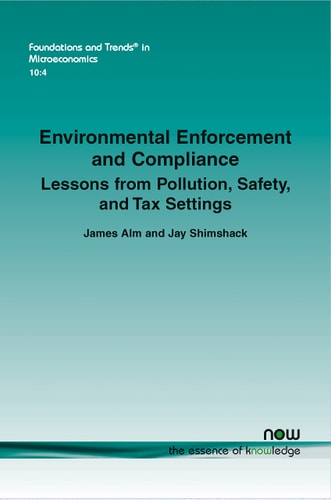
Environmental Enforcement and Compliance: Lessons from Pollution, Safety, and Tax Settings
0
0
As an Amazon Associate and affiliate partner, Menrva Books earns from qualifying purchases. Learn more
Author Description
Environmental Enforcement and Compliance: Lessons from Pollution, Safety, and Tax Settings reviews what economists do and do not know about the effectiveness and cost effectiveness of pollution monitoring and enforcement. The focus is mainly on lessons for and from the U.S. policy environment but discusses important research findings from international settings as well. The authors draw most of their insights from a subjective assessment of the existing theoretical, experimental, and empirical environmental economics literature but, where appropriate, lessons are drawn from criminal, tax compliance, and occupational health and safety settings. The criminal literature is examined because the historical law and economic foundations of the environmental enforcement literature were developed in this context. The tax context is considered because the availability of data have generated an especially rich and diverse theoretical, empirical, and experimental literature, which has also been often applied to environmental compliance. The authors draw on the health and safety literature because the Occupational Safety and Health Administration and the Environmental Protection Agency have similarly broad regulatory authority and often share institutional features. Environmental Enforcement and Compliance: Lessons from Pollution, Safety, and Tax Settings focuses is on five questions: (1) What do environmental monitoring and enforcement actions look like in the real world? (2) How do we assess environmental compliance and deterrence? (3) Do environmental monitoring and enforcement actions get results? (4) How, why, and when do inspections and sanctions achieve compliance and reduce pollution? And (5) what do the answers to the preceding questions tell us about designing and implementing more effective and more cost effective public policies for the environment? After an introduction, section 2 reviews key institutions. Section 3 discusses measuring environmental performance and
Menrva's Summary
THE THESIS
This book investigates the effectiveness and cost-effectiveness of environmental monitoring and enforcement strategies. The authors, James Alm and Jay Shimshak, draw upon extensive theoretical, experimental, and empirical literature from environmental economics, as well as insights from criminal, tax compliance, and occupational health and safety settings, to address five key questions. These questions explore the nature of real-world enforcement actions, methods for assessing compliance and deterrence, the actual results of these actions, the mechanisms by which inspections and sanctions achieve compliance, and ultimately, how these findings can inform the design of more effective public policies for environmental protection.
THE SCOPE MAP
- What environmental monitoring and enforcement actions look like in practice.
- Methods for assessing environmental compliance and deterrence.
- Empirical evidence on the results of environmental monitoring and enforcement.
- Analysis of how and why inspections and sanctions achieve compliance and reduce pollution.
- Lessons learned for designing and implementing more effective and cost-effective environmental policies.
- Discussion of key institutions involved in environmental regulation.
- Review of measurement of environmental performance.
THE AUTHORITY PERSPECTIVE
This book is an academic review that synthesizes existing research on environmental enforcement and compliance. It is likely to be of interest to scholars and policymakers in environmental economics and public policy. The work aims to provide a comprehensive overview of what is known and unknown regarding the efficacy of regulatory tools. The authors' approach of drawing lessons from related fields like tax and safety compliance suggests a broad and interdisciplinary perspective on the subject matter.
Page Count:
82
Publication Date:
2014-01-01
Publisher:
Now Publishers
ISBN-10:
1601988907
ISBN-13:
9781601988904
Non-Fiction
Science
Economics
Public Policy
Regulatory Compliance
Community Tags
Similar Books









Reader Comments
Share Your Thoughts
No comments yet. Be the first to share your thoughts!