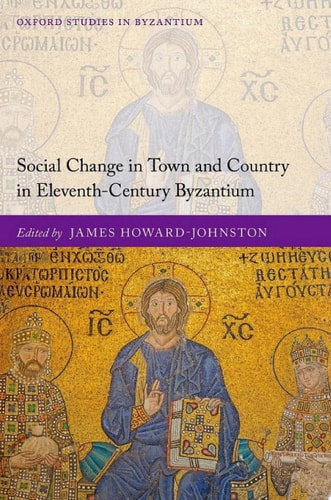
Social Change in Town and Country in Eleventh-Century Byzantium
0
0
As an Amazon Associate and affiliate partner, Menrva Books earns from qualifying purchases. Learn more
Author Description
The history of Byzantium pivots around the eleventh century, during which it reached its apogee in terms of power, prestige, and territorial extension, only then to plunge into steep political decline following serious military defeats and extensive territorial losses. The political, economic, and intellectual history of the period is reasonably well understood, but not so what was happening in that crucial intermediary sphere, the social order, which both shaped and was shaped by contemporary ideas and brute economic developments. This volume aims to deepen understanding of Byzantine society by examining material evidence for settlements and production in different regions and by sifting through the far from plentiful literary and documentary sources in order to track what was happening in town and country. There is evidence of significant change: the pattern of landownership continued to shift in favour of those with power and wealth, but there was sustained and effective resistance from peasant villages. Provincial towns prospered in what was an era of sustained economic growth, and, through newly emboldened local elites, took a more active part in public affairs. In the capital the middling classes, comprising much of officialdom and leading traders, gained in importance, while the twin military and civilian elites were merging to form a single governing class. However, despite this social upheaval, careful analysis of these various factors by a range of leading Byzantine historians and archaeologists leads to the overarching conclusion that it was not so much internal structural changes which contributed to the vertiginous decline suffered by Byzantium in the late eleventh century, as the unprecedented combination of dangerous adversaries on different fronts, in the east, north, and west.
Menrva's Summary
THE THESIS
This volume investigates the extent to which internal social and economic shifts in eleventh-century Byzantium contributed to the empire's rapid political decline. James Howard-Johnston and a collection of contributors analyze the interplay between provincial settlement patterns, landownership, and the evolution of urban and rural elites. By synthesizing archaeological material with limited literary and documentary evidence, the authors argue that external military pressures, rather than internal structural collapse, were the primary drivers of the empire's late-century instability.
THE SCOPE MAP
What You Will Find
- Analysis of landownership shifts and the resistance of peasant villages.
- Examination of the economic prosperity of provincial towns and the rise of local elites.
- Study of the merging of military and civilian governing classes in Constantinople.
- Integration of archaeological settlement data with historical textual sources.
Scope Limits
- The text focuses specifically on the eleventh century and does not provide a comprehensive history of the entire Byzantine era.
- It does not offer a detailed military history of the specific battles that led to the empire's territorial losses.
THE AUTHORITY PERSPECTIVE
Scholars and historians recognize this work as a significant contribution to the study of Byzantine social structures, particularly for its effort to bridge the gap between archaeological findings and traditional textual analysis. Readers frequently note the academic density of the prose, which makes it a specialized resource intended for students and researchers of medieval history.
Page Count:
320
Publication Date:
2020-01-01
Publisher:
OUP Oxford
ISBN-10:
0192578685
ISBN-13:
9780192578686
History
Economics
Archaeology
Greece
Social History
European History
Ancient History
Byzantine History
Community Tags
Other Editions(2)
Similar Books


Reader Comments
Share Your Thoughts
No comments yet. Be the first to share your thoughts!