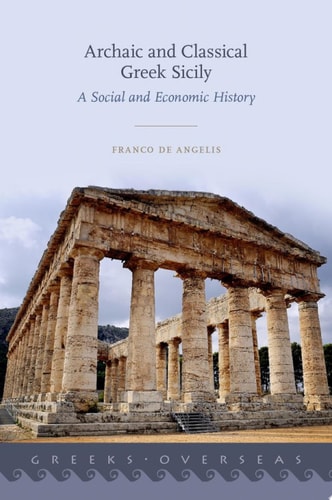
Archaic and Classical Greek Sicily: A Social and Economic History
0
0
As an Amazon Associate and affiliate partner, Menrva Books earns from qualifying purchases. Learn more
Author Description
Ancient Greek migrants in Sicily produced societies and economies that both paralleled and differed from their homeland. Explanations for these similarities and differences have been hotly debated. On the one hand, some scholars have viewed the ancient Greeks as one in a long line of migrants who were shaped by Sicily and its inhabitants. On the other hand, other scholars have argued that the Greeks acted as the main source of innovation and achievement in the culture of ancient Sicily, a culture that was still removed from that of mainland Greece. Neither of these positions is completely satisfactory. What is lacking in this debate is a basic framework for understanding ancient Sicily's social and economic history. Archaic and Classical Greek Sicily represents the first ever systematic and comprehensive attempt to synthesize the historical and archaeological evidence, and to deploy it to test the various historical models proposed over the past two centuries. It adopts an interdisciplinary approach that combines classical and prehistoric studies, texts and material culture, and a variety of methods and theories to put the history of Greek Sicily on a completely new footing. While Sicily and Greece had conjoined histories from the start, their relationship was not one of periphery and center or of colony and state in any sense, but of an interdependent and mutually enriching diaspora. At the same time, local conditions and peoples, including Phoenician migrants, also shaped the evolution of Sicilian Greek societies and economies. This book reveals and explains the similarities and differences between developments in Greek Sicily and the mainland, and brings greater clarity to the parts played by locals and immigrants in ancient Sicily's impressive achievements.
Menrva's Summary
THE THESIS
This book investigates the social and economic development of Greek settlements in Sicily to determine how these societies diverged from or mirrored their mainland counterparts. Franco De Angelis, a scholar specializing in Greek colonization and the ancient Mediterranean, synthesizes two centuries of historical and archaeological data. He challenges the binary view of Sicily as either a passive recipient of Greek culture or a transformative environment that dictated the terms of migrant life, proposing instead a model of interdependent diaspora.
THE SCOPE MAP
What You Will Find
- A systematic synthesis of historical texts and material culture from the Archaic and Classical periods.
- An interdisciplinary framework integrating prehistoric studies with classical historiography.
- Comparative analysis of Greek mainland developments versus Sicilian colonial outcomes.
Scope Limits
- The text focuses primarily on the social and economic structures rather than political or military history.
- The analysis is bounded by the Archaic and Classical periods, excluding later Hellenistic or Roman developments.
THE AUTHORITY PERSPECTIVE
Experts recognize this work as a foundational synthesis that provides a necessary framework for understanding the complexities of the Greek diaspora in the West. Readers frequently note the academic density of the prose, which is intended for scholars and advanced students of Mediterranean history.
Page Count:
459
Publication Date:
2016-01-01
Publisher:
Oxford University Press
ISBN-10:
0190613998
ISBN-13:
9780190613990
History
Greeks
Archaeology
Sicily
Greece
Social History
Ancient History
Foreign countries
Economic History
Community Tags
Other Editions(2)
Similar Books