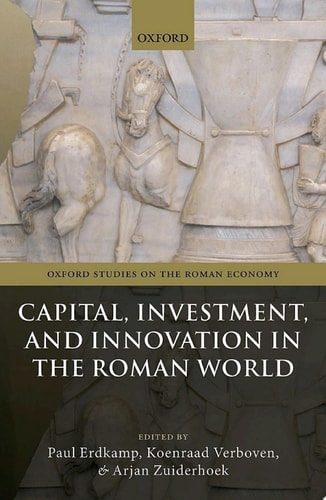
Capital, Investment, and Innovation in the Roman World
0
0
As an Amazon Associate and affiliate partner, Menrva Books earns from qualifying purchases. Learn more
Author Description
Investment in capital, both physical and financial, and innovation in its uses are often considered the linchpin of modern economic growth, while credit and credit markets now seem to determine the wealth - as well as the fate - of nations. Yet was it always thus? The Roman economy was large, complex, and sophisticated, but in terms of its structural properties did it look anything like the economies we know and are familiar with today? Through consideration of the allocation and uses of capital and credit and the role of innovation in the Roman world, the individual essays comprising this volume go straight to the heart of the matter, exploring such questions as how capital in its various forms was generated, allocated, and employed in the Roman economy; whether the Romans had markets for capital goods and credit; and whether investment in capital led to innovation and productivity growth. Their authors consider multiple aspects of capital use in agriculture, water management, trade, and urban production, and of credit provision, finance, and human capital, covering different periods of Roman history and ranging geographically across Italy and elsewhere in the Roman world. Utilizing many different types of written and archaeological evidence, and employing a range of modern theoretical perspectives and methodologies, the contributors, an expert international team of historians and archaeologists, have produced the first book-length contribution to focus exclusively on (physical and financial) capital in the Roman world; a volume that is aimed not only at specialists in the field, but also at economic historians and archaeologists specializing in other periods and places.
Menrva's Summary
THE THESIS
This volume investigates whether the structural properties of the Roman economy, specifically regarding capital allocation, credit markets, and innovation, mirror those of modern economic systems. The editors, Arjan Zuiderhoek, Koenraad Verboven, and Paul Erdkamp, assemble an international team of historians and archaeologists to analyze how Roman capital was generated and employed. By applying modern theoretical frameworks to ancient data, the contributors assess whether Roman investment practices fostered productivity growth or functioned under fundamentally different constraints.
THE SCOPE MAP
What You Will Find
- Analysis of capital use in agriculture, water management, trade, and urban production.
- Examination of credit provision, financial systems, and human capital development.
- Integration of written records and archaeological findings.
Scope Limits
- The volume does not provide a comprehensive history of the entire Roman economy but focuses specifically on capital and innovation.
- It does not attempt to force modern economic models onto ancient society without critical qualification.
THE AUTHORITY PERSPECTIVE
Experts recognize this work as a foundational text for understanding the financial mechanics of the Roman world. Readers frequently note the academic density of the prose, which is intended for specialists in economic history and archaeology.
Page Count:
512
Publication Date:
2020-01-01
Publisher:
OUP Oxford
ISBN-10:
0192578960
ISBN-13:
9780192578969
Economics
History
Archaeology
Ancient - Rome
Economic History
Ancient History
European History
Community Tags
Other Editions(3)
Similar Books






Reader Comments
Share Your Thoughts
No comments yet. Be the first to share your thoughts!