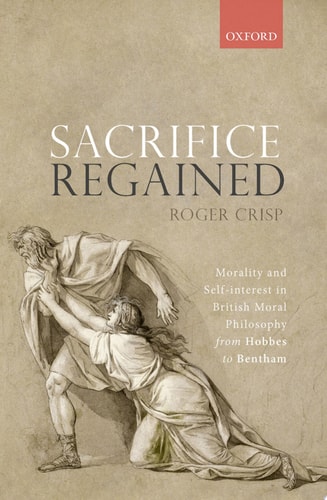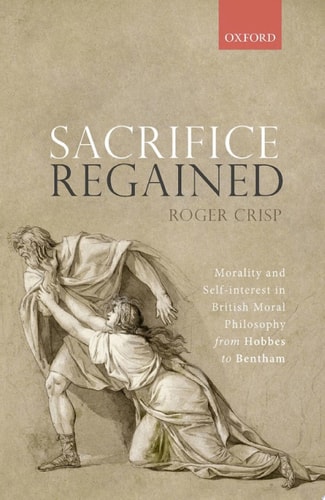
Sacrifice Regained: Morality and Self-Interest in British Moral Philosophy from Hobbes to Bentham
0
0
As an Amazon Associate and affiliate partner, Menrva Books earns from qualifying purchases. Learn more
Author Description
Does being virtuous make you happy? Roger Crisp examines the answers to this ancient question provided by the so-called 'British Moralists', from Thomas Hobbes, around 1650, for the next two hundred years, until Jeremy Bentham. This involves elucidating their views on happiness (self-interest, or well-being) and on virtue (or morality), in order to bring out the relation of each to the other. Themes ran through many of these writers: psychological egoism, evaluative hedonism, and—after Hobbes—the acceptance of self-standing moral reasons. But there are exceptions, and even those taking the standard views adopt them for very different reasons and express them in various ways. As the ancients tended to believe that virtue and happiness largely coincide, so these modern authors are inclined to accept posthumous reward and punishment. Both positions sit uneasily with the common-sense idea that a person can truly sacrifice their own good for the sake of morality or for others. This book shows that David Hume—a hedonist whose ethics made no appeal to the afterlife—was the first major British moralist to allow for, indeed to recommend, such self-sacrifice. Morality and well-being of course remain central to modern ethics, and Crisp demonstrates how much there is to learn from this remarkable group of philosophers.
Menrva's Summary
THE THESIS
This book investigates the historical tension between self-interest and moral virtue within British moral philosophy from the mid-seventeenth century to the nineteenth century. Roger Crisp, a scholar of moral philosophy, analyzes the works of thinkers from Thomas Hobbes to Jeremy Bentham to determine how they reconciled the pursuit of personal happiness with the demands of ethical behavior. He argues that while many of these philosophers relied on the afterlife to align virtue with self-interest, David Hume introduced a significant shift by advocating for self-sacrifice without such theological guarantees.
THE SCOPE MAP
What You Will Find
- Analysis of psychological egoism and evaluative hedonism in British thought
- Examination of the transition from Hobbesian egoism to Benthamite utilitarianism
- Detailed study of David Hume's unique contribution to moral self-sacrifice
- Exploration of the role of posthumous reward and punishment in early modern ethics
Scope Limits
- The analysis is restricted to British moralists between 1650 and the era of Jeremy Bentham
- The text does not provide a comprehensive survey of contemporary or non-British ethical frameworks
THE AUTHORITY PERSPECTIVE
Scholars recognize this work as a rigorous examination of the evolution of British ethical thought regarding the compatibility of virtue and well-being. Readers frequently note the academic density of the prose and the precision with which Crisp navigates the nuanced arguments of these historical figures.
Page Count:
243
Publication Date:
2019-01-01
Publisher:
OUP Oxford
ISBN-10:
019257695X
ISBN-13:
9780192576958
Philosophy
Non-Fiction
British Moralists
Philosophy Modern
History & Surveys
Philosophy history
Ethics
Community Tags
Similar Books