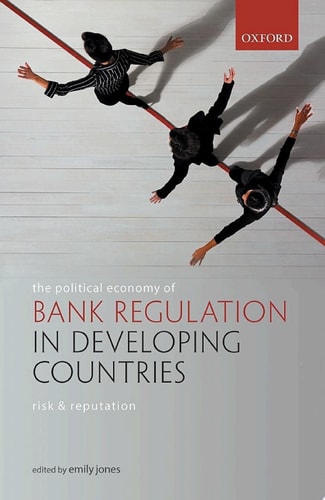
The Political Economy of Bank Regulation in Developing Countries: Risk and Reputation
0
0
As an Amazon Associate and affiliate partner, Menrva Books earns from qualifying purchases. Learn more
Author Description
This is an open access title available under the terms of a CC BY-NC-ND 4.0 International licence. It is free to read at Oxford Scholarship Online and offered as a free PDF download from OUP and selected open access locations. International banking standards are intended for the regulation of large, complex, risk-taking international banks with trillions of dollars in assets and operations across the globe. Yet they are being implemented in countries with nascent financial markets and small banks that have yet to venture into international markets. Why is this? The Political Economy of Bank Regulation in Developing Countries: Risk and Reputation explores the politics of banking regulation in eleven countries across Africa, Asia, and Latin America. It shows how financial globalization generates strong reputational and competitive incentives for developing countries to converge on international standards. Politicians, regulators, and large banks in developing countries implement international standards to attract international investment, bolster their professional standing, and further integrate their countries into global finance. Convergence is not inevitable or uniform: implementation is often contested and regulators adapt international standards to the local context. This book contributes to our understanding of the ways in which governments and firms in the core of global finance powerfully shape regulatory decisions in the periphery, and the ways that governments and firms from peripheral developing countries manoeuvre within the constraints and opportunities created by financial globalization.
Menrva's Summary
THE THESIS
This book investigates why developing countries choose to implement complex international banking standards despite the significant differences between their nascent financial markets and the global institutions for which these standards were designed. Emily Jones, an expert in international political economy, utilizes a comparative framework to analyze the regulatory environments of eleven nations across Africa, Asia, and Latin America. The author argues that the drive for convergence is primarily motivated by reputational incentives and the desire to attract foreign investment, rather than purely technical necessity.
THE SCOPE MAP
What You Will Find
- Comparative analysis of banking regulation across eleven countries in Africa, Asia, and Latin America.
- Examination of the reputational and competitive pressures exerted by financial globalization.
- Discussion of how local regulators adapt international standards to fit domestic contexts.
Scope Limits
- The study does not provide a comprehensive global survey of every developing nation.
- The analysis focuses primarily on the political and economic drivers of regulation rather than the technical implementation of specific accounting software or banking hardware.
THE AUTHORITY PERSPECTIVE
Experts recognize this work as a significant contribution to the study of how global financial norms influence peripheral economies. Readers frequently note the academic rigor of the prose and the clarity with which Jones explains the complex interplay between domestic political actors and international financial institutions.
Page Count:
404
Publication Date:
2020-01-01
Publisher:
OUP Oxford
ISBN-10:
0192579231
ISBN-13:
9780192579232
Economics
Public Policy
Finance
International relations
Globalization
Community Tags
Similar Books