Water Treatment Using Adsorption on Soil
0
0
As an Amazon Associate and affiliate partner, Menrva Books earns from qualifying purchases. Learn more
Author Description
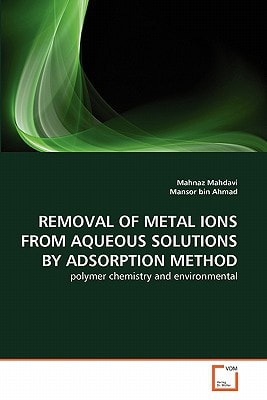
Discharge of heavy metals in wastewater can be toxic to aquatic life and render natural waters as they become unsuitable for human consumption due to their tendency to accumulate in living organisms. These problem are good reasons to search an efficient economically cheap methods with easy technology to removal heavy from polluted water. The removal of heavy metals from aqueous solutions in this work herein is investigated by an adsorption of heavy metals on a local Libyan Soil called Ashkida soil mined in the Southern Province of Libya. The soil efficiency and removal capacity of heavy metals from aqueous solutions was experimentally investigated in a batch system. The experiments are performed in a batch system at room temperature. It is aimed to study the effects of some parameters of heavy metals adsorption capacity on the soil. A comparison of equilibrium isotherms and kinetic models applied to the adsorption of heavy metals ions on the adsorbent, and parameters were calculated. The adsorption process was physisorption and controlled by an endothermic reaction; however, an efficient heavy metals removal can be achieved at ambient temperature.
Menrva's Summary
THE THESIS
This work investigates the efficacy of a local Libyan soil, Ashkida soil, as an economically viable adsorbent for removing toxic heavy metals from polluted wastewater. The study details experimental investigations into the soil's removal capacity and efficiency using a batch system at room temperature. It examines the influence of various parameters on heavy metal adsorption and analyzes equilibrium isotherms and kinetic models to understand the adsorption process, concluding that it is a physisorption process controlled by an endothermic reaction, effective at ambient temperatures.
THE SCOPE MAP
- Experimental investigation of Ashkida soil's heavy metal adsorption capacity.
- Batch system experiments conducted at room temperature.
- Analysis of parameters affecting heavy metal adsorption.
- Application and comparison of equilibrium isotherms and kinetic models.
- Determination of adsorption process characteristics (physisorption, endothermic reaction).
THE AUTHORITY PERSPECTIVE
This technical study presents a focused investigation into a specific adsorbent material for heavy metal removal. The methodology described suggests a detailed experimental approach to quantify adsorption efficiency and kinetics. The findings are likely to be of interest to researchers and practitioners in environmental engineering and water treatment seeking cost-effective solutions for industrial wastewater remediation.
Page Count:
100
Publication Date:
2010-10-01
Publisher:
Lap Lambert Academic Publishing GmbH KG
ISBN-10:
3843363900
ISBN-13:
9783843363907
Science
Non-Fiction
Water Treatment
Heavy metals
Soil Science
Adsorption
Community Tags
Similar Books