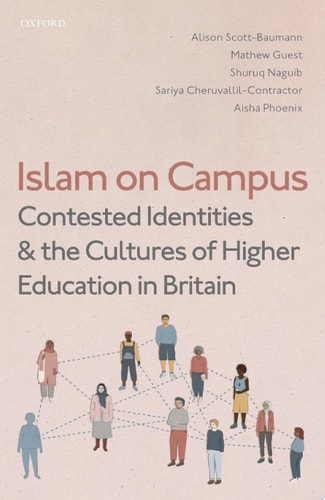
Islam on Campus: Contested Identities and the Cultures of Higher Education in Britain
0
0
As an Amazon Associate and affiliate partner, Menrva Books earns from qualifying purchases. Learn more
Author Description
Islam on Campus explores how Islam is represented, perceived and lived within higher education in Britain. It is a book about the changing nature of university life, and the place of religion within it. Even while many universities maintain ambiguous or affirming orientations to religious institutions for reasons to do with history and ethos, much western scholarship has presumed higher education to be a strongly secularizing force. This framing has resulted in religion often being marginalized or ignored as a cultural irrelevance by the university sector. However, recent times have seen higher education increasingly drawn into political discourses that problematize religion in general, and Islam in particular, as an object of risk. Using the largest data set yet collected in the UK, this book explores university life and the ways in which ideas about Islam and Muslim identities are produced, experienced, perceived, appropriated, and objectified. It asks what role universities and Muslim higher education institutions play in the production, reinforcement, and contestation of emerging narratives about religious difference. This is a culturally nuanced treatment of universities as sites of knowledge production, and contexts for the negotiation of perspectives on culture and religion among an emerging generation. It demonstrates the urgent need to release Islam from its official role as the othered, the feared. When universities achieve this we will be able to help students of all affiliations and of none to be citizens of the campus in preparation for being citizens of the world.
Menrva's Summary
THE THESIS
This book investigates how Islam is represented, perceived, and experienced within the context of British higher education, challenging the assumption that universities are inherently secularizing forces. The authors, a team of researchers specializing in sociology and religious studies, utilize a comprehensive empirical framework to analyze how universities function as sites for the negotiation of religious identity. They argue that higher education institutions are increasingly drawn into political discourses that frame Islam as a risk, necessitating a shift in how these institutions engage with religious diversity.
THE SCOPE MAP
What You Will Find
- Analysis of the largest data set collected on Islam in UK higher education to date.
- Examination of university policies and institutional orientations toward religious institutions.
- Exploration of how Muslim identities are produced and contested within academic environments.
- Case studies on the role of universities in shaping narratives about religious difference.
Scope Limits
- The study is geographically limited to the United Kingdom higher education sector.
- The research focuses primarily on the intersection of Islam and secular university structures rather than global theological debates.
THE AUTHORITY PERSPECTIVE
Experts highlight this work as a significant contribution to the sociology of religion and education, noting its empirical rigor in addressing a sensitive and contemporary political topic. Readers frequently observe that the text provides a necessary, evidence-based counter-narrative to common media portrayals of Islam on university campuses.
Page Count:
288
Publication Date:
2020-01-01
Publisher:
OUP Oxford
ISBN-10:
0192586009
ISBN-13:
9780192586001
Religion
Higher Education
Sociology
Education
Social Science
Islam
British Studies
Education - History
Community Tags
Similar Books