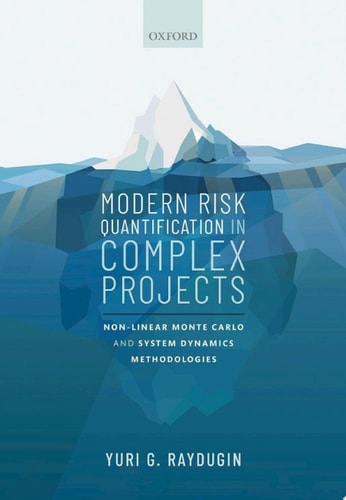
Modern Risk Quantification in Complex Projects: Non-linear Monte Carlo and System Dynamics Methodologies
0
0
As an Amazon Associate and affiliate partner, Menrva Books earns from qualifying purchases. Learn more
Author Description
Project practitioners and decision makers complain that both parametric and Monte Carlo methods fail to produce accurate project duration and cost contingencies in majority of cases. Apparently, the referred methods have unacceptably high systematic errors as they miss out critically important components of project risk exposure. In the case of complex projects overlooked are the components associated with structural and delivery complexity. Modern Risk Quantification in Complex Projects: Non-linear Monte Carlo and System Dynamics Methodologies zeroes in on most crucial but systematically overlooked characteristics of complex projects. Any mismatches between two fundamental interacting subsystems - a project structure subsystem and a project delivery subsystem - result in non-linear interactions of project risks. Three kinds of the interactions are distinguished - internal risk amplifications stemming from long-term ('chronic') project system issues, knock-on interactions, and risk compounding. Affinities of interacting risks compose dynamic risk patterns supported by a project system. A methodology to factor the patterns into Monte Carlo modelling referred to as non-linear Monte Carlo schedule and cost risk analysis (N-SCRA) is developed and demonstrated. It is capable to forecast project outcomes with high accuracy even in the case of most complex and difficult projects including notorious projects-outliers: it has a much lower systematic error. The power of project system dynamics is uncovered. It can be adopted as an accurate risk quantification methodology in complex projects. Results produced by the system dynamics and the non-linear Monte Carlo methodologies are well-aligned. All built Monte Carlo and system dynamics models are available on the book's companion website.
Menrva's Summary
THE THESIS
This book investigates why traditional parametric and Monte Carlo methods frequently fail to accurately predict cost and duration in complex projects, proposing non-linear modeling as a solution. Author Yuri G. Raydugin, a specialist in project risk, argues that standard models overlook structural and delivery complexity. He introduces a framework that accounts for non-linear risk interactions, such as internal amplification and compounding, to improve the accuracy of project forecasting.
THE SCOPE MAP
What You Will Find
- Non-linear Monte Carlo schedule and cost risk analysis (N-SCRA) methodology
- System dynamics modeling for project risk identification
- Analysis of project structure versus project delivery subsystems
- Case studies of project outliers
Scope Limits
- The text focuses specifically on complex, large-scale projects rather than simple or routine tasks.
- It assumes a baseline familiarity with standard Monte Carlo simulation techniques.
THE AUTHORITY PERSPECTIVE
Practitioners in the field of project management view this work as a technical resource for addressing systematic errors in risk quantification. Experts highlight the book's utility for those seeking to integrate system dynamics into their existing risk modeling workflows.
Page Count:
384
Publication Date:
2020-01-01
Publisher:
OUP Oxford
ISBN-10:
0192582658
ISBN-13:
9780192582652
Business
Operations Research
Mathematics Statistics
Engineering
Probability
Community Tags
Other Editions(2)
Similar Books












Reader Comments
Share Your Thoughts
No comments yet. Be the first to share your thoughts!