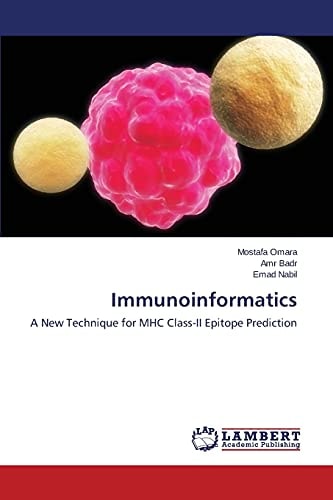
Immunoinformatics: A New Technique for MHC Class-II Epitope Prediction
0
0
As an Amazon Associate and affiliate partner, Menrva Books earns from qualifying purchases. Learn more
Author Description
Identification of Major Histocompatibility Complex (MHC) binding peptides is an important step in the selection of T-Cell epitope candidates that are suitable for usage in new vaccines. The binding groove of the MHC Class-II molecule is opened at both sides, which allows for high variability in length of the peptides that bind to this molecule and consequently; complicates the prediction of the binding core motif. An accurate and efficient computational approach for the prediction of such peptides can greatly reduce the time and cost required for the design of new vaccines. EpiGASVM, a new approach for the in silico prediction of MHC Class-II epitopes was developed by combining Genetic Algorithms and Support Vector Machines. Nine variations of EpiGASVM were applied to two sets of similarity-reduced benchmark data. The prediction accuracy and area under the receiver operating characteristic curve were calculated as measures of performance. The technique is compared with some state-of-the-art techniques in this area (e.g. ARB, SMM-Align, PROPRED, NN-Align). Results shows that EpiGASVM is a promising new technique for the solution of the MHC Class-II epitope prediction problem.
Menrva's Summary
THE THESIS
The challenge lies in accurately predicting peptide binding to MHC Class-II molecules for vaccine development. The binding groove of MHC Class-II molecules allows for variable peptide lengths, complicating the prediction of the binding core motif. This research introduces EpiGASVM, a novel computational approach that combines Genetic Algorithms and Support Vector Machines to address this challenge. By applying nine variations of EpiGASVM to similarity-reduced benchmark data, the study evaluates prediction accuracy and performance metrics, comparing the technique against existing state-of-the-art methods.
THE SCOPE MAP
- A novel computational approach for MHC Class-II epitope prediction: EpiGASVM.
- Integration of Genetic Algorithms and Support Vector Machines for enhanced prediction.
- Application of nine variations of EpiGASVM to benchmark datasets.
- Performance evaluation using prediction accuracy and area under the ROC curve.
- Comparative analysis against established techniques like ARB, SMM-Align, PROPRED, and NN-Align.
- Discussion of EpiGASVM's potential as a promising technique for MHC Class-II epitope prediction.
THE AUTHORITY PERSPECTIVE
The research presents EpiGASVM as a novel computational technique for predicting MHC Class-II epitopes, a critical step in vaccine design. The methodology combines Genetic Algorithms with Support Vector Machines, and its performance is evaluated against existing state-of-the-art methods. The results indicate that EpiGASVM shows promise in addressing the complexities of MHC Class-II binding peptide prediction.
Page Count:
116
Publication Date:
2015-01-01
Publisher:
Lap Lambert Academic Publishing GmbH KG
ISBN-10:
3659778001
ISBN-13:
9783659778001
Science & Technology
Science
Health
Non-Fiction
Computer Science
Community Tags
Similar Books