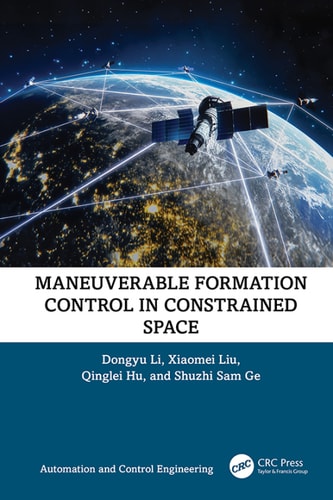
Maneuverable Formation Control in Constrained Space
0
0
As an Amazon Associate and affiliate partner, Menrva Books earns from qualifying purchases. Learn more
Author Description
Inspired by the community behaviors of animals and humans, cooperative control has been intensively studied by numerous researchers in recent years. Cooperative control aims to build a network system collectively driven by a global objective function in a distributed or centralized communication network and shows great application potential in a wide domain. From the perspective of cybernetics in network system cooperation, one of the main tasks is to design the formation control scheme for multiple intelligent unmanned systems, facilitating the achievements of hazardous missions – e.g., deep space exploration, cooperative military operation, and collaborative transportation. Various challenges in such real-world applications are driving the proposal of advanced formation control design, which is to be addressed to bring academic achievements into real industrial scenarios. This book extends the performance of formation control beyond classical dynamic or stationary geometric configurations, focusing on formation maneuverability that enables cooperative systems to keep suitable spacial configurations during agile maneuvers. This book embarks on an adventurous journey of maneuverable formation control in constrained space with limited resources, to accomplish the exploration of an unknown environment. The investigation of the real-world challenges, including model uncertainties, measurement inaccuracy, input saturation, output constraints, and spatial collision avoidance, brings the value of this book into the practical industry, rather than being limited to academics.
Menrva's Summary
THE THESIS
This book investigates the design of formation control schemes for multiple intelligent unmanned systems operating in constrained spaces with limited resources. It extends the performance of formation control beyond classical dynamic or stationary geometric configurations, focusing on formation maneuverability that enables cooperative systems to maintain suitable spatial configurations during agile maneuvers. The work addresses real-world challenges such as model uncertainties, measurement inaccuracy, input saturation, output constraints, and spatial collision avoidance, aiming to bridge academic achievements with practical industrial applications in areas like deep space exploration and cooperative military operations.
THE SCOPE MAP
- Cooperative control strategies inspired by biological systems.
- Formation maneuverability for agile and dynamic configurations.
- Handling of model uncertainties, measurement inaccuracy, and input/output constraints.
- Spatial collision avoidance algorithms for multi-agent systems.
- Application potential in deep space exploration, military operations, and collaborative transportation.
- Integration of academic research into practical industrial scenarios.
THE AUTHORITY PERSPECTIVE
The book presents an advanced approach to formation control, focusing on maneuverability in constrained environments, which is crucial for complex real-world applications. Its emphasis on addressing practical challenges like uncertainties and collision avoidance suggests a strong orientation towards engineering and applied science. The work appears to target researchers and practitioners in robotics, control systems, and artificial intelligence seeking to implement cooperative control strategies in demanding operational settings.
Page Count:
212
Publication Date:
2024-05-14
Publisher:
Taylor & Francis
ISBN-10:
1040015492
ISBN-13:
9781040015490
Science
Non-Fiction
Science & Technology
Engineering
Control systems
Robotics
Community Tags
Similar Books