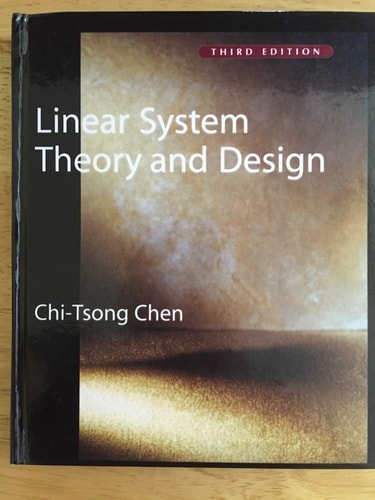
Linear System Theory and Design
0
0
As an Amazon Associate and affiliate partner, Menrva Books earns from qualifying purchases. Learn more
Author Description
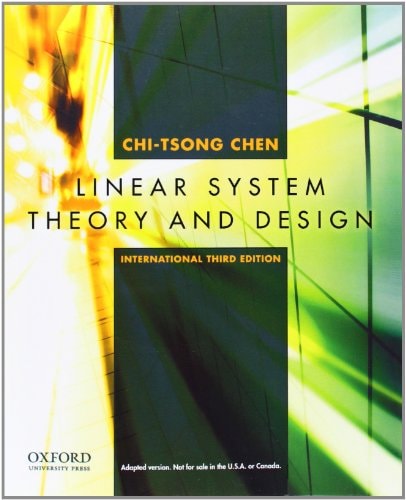
An extensive revision of the author's highly successful text, this third edition of Linear System Theory and Design has been made more accessible to students from all related backgrounds. After introducing the fundamental properties of linear systems, the text discusses design using state equations and transfer functions. In state-space design, Lyapunov equations are used extensively to design state feedback and state estimators. In the discussion of transfer-function design, pole placement, model matching, and their applications in tracking and disturbance rejection are covered. Both one-and two-degree-of-freedom configurations are used. All designs can be accomplished by solving sets of linear algebraic equations.The two main objectives of the text are to: use simple and efficient methods to develop results and design procedures; enable students to employ the results to carry out design. All results in this new edition are developed for numerical computation and illustrated using MATLAB, with an emphasis on the ideas behind the computation and interpretation of results. This book develops all theorems and results in a logical way so that readers can gain an intuitive understanding of the theorems. This revised edition begins with the time-invariant case and extends through the time-varying case. It also starts with single-input single-output design and extends to multi-input multi-output design. Striking a balance between theory and applications, Linear System Theory and Design, 3/e, is ideal for use in advanced undergraduate/first-year graduate courses in linear systems and multivariable system design in electrical, mechanical, chemical, and aeronautical engineering departments. It assumes a working knowledge of linear algebra and the Laplace transform and an elementary knowledge of differential equations.
Menrva's Summary
THE THESIS
This text investigates the fundamental principles and practical design methodologies required to analyze and control linear systems within engineering contexts. Chi-Tsong Chen, a recognized authority in the field, provides a rigorous framework that bridges the gap between theoretical linear algebra and applied system design. By focusing on state-space representations and transfer functions, the author equips students and practitioners with the mathematical tools necessary to solve complex problems in electrical, mechanical, and aeronautical engineering. The work emphasizes numerical computation and intuitive understanding, ensuring that theoretical results are directly applicable to real-world system modeling and feedback control.
THE SCOPE MAP
What You Will Find
- Comprehensive coverage of state-space design, including state feedback and state estimators using Lyapunov equations.
- Detailed analysis of transfer-function design, covering pole placement, model matching, and disturbance rejection.
- Integration of MATLAB for numerical computation and interpretation of system behavior.
- A systematic progression from single-input single-output (SISO) to multi-input multi-output (MIMO) systems.
THE AUTHORITY PERSPECTIVE
Experts and educators frequently cite this text as a foundational resource for advanced undergraduate and graduate-level courses in control theory. Readers often note the academic density of the prose, which requires a solid prerequisite understanding of linear algebra and differential equations to fully grasp the presented methodologies.
Page Count:
352
Publication Date:
1998-09-10
Publisher:
Oxford University Press
ISBN-10:
0195117778
ISBN-13:
9780195117776
Electrical Engineering
Linear Systems
Engineering
Control systems
textbook
Mathematics
System Design
Community Tags
Other Editions(8)


Similar Books



Reader Comments
Share Your Thoughts
No comments yet. Be the first to share your thoughts!