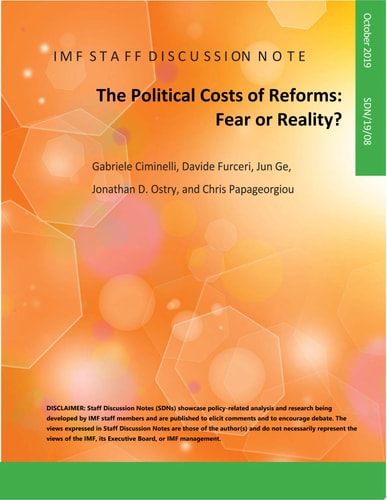
The Political Costs of Reforms: Fear or Reality?
0
0
As an Amazon Associate and affiliate partner, Menrva Books earns from qualifying purchases. Learn more
Author Description
Many countries are experiencing persistent, weak medium-term growth and limited fiscal space. Against this background, economic policy agendas—in both advanced and developing economies—are focusing increasingly on structural reforms. While there is broad agreement on the economic benefits of structural reforms, the political-economy of reform is less settled. This is because reforms may generate gains only in the longer term while distributional effects may be sizable in the short run, and because governments may lack political capital to confront vocal interest groups. In these circumstances, politicians may hold back on reforms, fearing they will be penalized at the ballot box. The aim of this Staff Discussion Note is to examine whether the fear of a political cost associated with structural reforms is justified by the available evidence, and whether there are lessons from the data about how reform strategies might be designed to mitigate potential political costs. It provides a major addition to recent IMF analysis examining the output and employment effect of reforms
Menrva's Summary
THE THESIS
This Staff Discussion Note investigates whether politicians' fears of electoral penalties for implementing structural economic reforms are substantiated by evidence, and explores strategies to mitigate these political costs. The note addresses the challenge of weak medium-term growth and limited fiscal space by examining the focus on structural reforms in both advanced and developing economies. It acknowledges that while reforms offer long-term economic benefits, their short-term distributional effects and the potential opposition from vocal interest groups can deter governments. The analysis aims to provide data-driven insights into the political economy of reform, building upon recent IMF work on the effects of reforms on output and employment.
THE SCOPE MAP
- Analysis of the political-economy of structural economic reforms.
- Examination of the fear of electoral penalties associated with reforms.
- Assessment of the short-term distributional effects versus long-term economic benefits of reforms.
- Exploration of strategies to design reform approaches that mitigate political costs.
- Data-driven insights into the relationship between reforms and electoral outcomes.
- Contribution to recent IMF analysis on the output and employment effects of reforms.
THE AUTHORITY PERSPECTIVE
This Staff Discussion Note, authored by economists from the IMF, provides an analytical perspective on the political challenges of implementing economic reforms. The work is framed as an examination of empirical evidence to determine if the perceived political costs of reforms are a significant deterrent for policymakers. It aims to offer practical lessons for designing reform strategies that can navigate potential political backlash, contributing to the ongoing discourse on economic policy effectiveness.
Page Count:
30
Publication Date:
2019-10-18
Publisher:
International Monetary Fund
ISBN-10:
1513517155
ISBN-13:
9781513517155
Economics
Non-Fiction
Politics
Policy
Community Tags
Similar Books