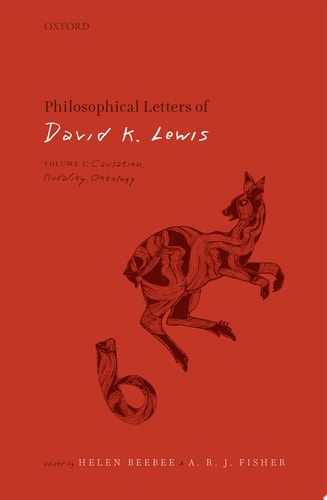
Philosophical Letters Of David K. Lewis: Volume 2
Author Description
David Kellogg Lewis (1941-2001) Was One Of The Most Influential Philosophers Of The Twentieth Century. He Made Significant Contributions To Almost Every Area Of Analytic Philosophy Including Metaphysics, Philosophy Of Language, Philosophy Of Mind, And Philosophy Of Science, And Set The Agenda For Various Debates In These Areas Which Carry On To This Day. In Several Respects He Remains A Contemporary Figure, Yet Enough Time Has Now Passed For Historians Of Philosophy To Begin To Study His Place In Twentieth Century Thought. His Philosophy Was Constructed And Refined Not Just Through His Published Writing, But Also Crucially Through His Life-long Correspondence With Fellow Philosophers, Including Leading Figures Such As D.m. Armstrong, Saul Kripke, W.v. Quine, J.j.c. Smart, And Peter Van Inwagen. His Letters Formed The Undercurrent Of His Published Work And Became The Medium Through Which He Proposed Many Of His Well-known Theories And Discussed A Range Of Philosophical Topics In Depth. A Selection Of His Vast Correspondence Over A 40-year Period Is Presented Here Across Two Volumes. Structured In Three Parts, Volume 2 Explores Lewis' Contributions To Philosophical Questions Of Mind, Language, And Epistemology Respectively. The Letters Address Lewis's Answer To The Mind-body Problem, Propositional Attitudes And The Purely Subjective Character Of Conscious Experience, Meaning And Reference As Well As Grammar In Language, Vagueness, Truth In Fiction, The Problem Of Scepticism, And Lewis's Work On Decision Theory And Rationality, Among Many Other Topics. This Volume Is A Testament To Lewis' Achievement In These Areas And Will Be An Invaluable Resource For Those Exploring Contemporary Debates Concerning Mind, Language, And Epistemology.
Menrva's Summary
THE THESIS
This collection investigates the development of David K. Lewis’s influential philosophical theories through the lens of his private correspondence with other prominent thinkers. The work presents a curated selection of letters written by Lewis over a 40-year career, documenting the evolution of his ideas in metaphysics, language, and mind. By examining these exchanges, the text provides insight into the collaborative and iterative nature of analytic philosophy during the late twentieth century.
THE SCOPE MAP
What You Will Find
- Correspondence with figures such as D.M. Armstrong, Saul Kripke, and W.V. Quine
- Detailed discussions on the mind-body problem and propositional attitudes
- Analysis of meaning, reference, and grammar in language
- Explorations of decision theory, rationality, and the problem of skepticism
Scope Limits
- This volume focuses specifically on mind, language, and epistemology rather than his entire body of work
- The letters are a selection and do not represent the entirety of his private archives
THE AUTHORITY PERSPECTIVE
Scholars and historians of philosophy view this collection as a critical resource for understanding the intellectual underpinnings of Lewis's published work. Readers frequently note the academic density of the prose, which is intended for those already familiar with contemporary analytic debates.
Page Count:
480
Publication Date:
2020-01-01
Publisher:
Oxford University Press
ISBN-10:
0192597876
ISBN-13:
9780192597878
Philosophy
Epistemology
Correspondence
Philosophy of
Metaphysics
Academic
Community Tags
Similar Books