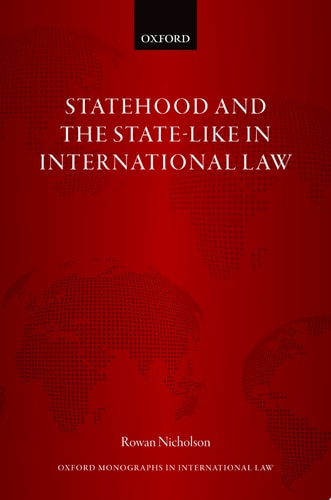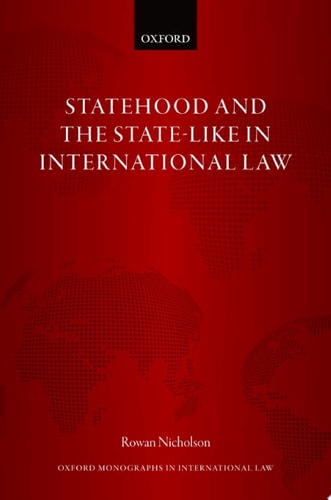
Statehood and the State-Like in International Law
0
0
As an Amazon Associate and affiliate partner, Menrva Books earns from qualifying purchases. Learn more
Author Description
If the term were given its literal meaning, international law would be law between 'nations'. It is often described instead as being primarily between states. But this conceals the diversity of the nations or state-like entities that have personality in international law or that have had it historically. This book reconceptualizes statehood by positioning it within that wider family of state-like entities. In this monograph, Rowan Nicholson contends that states themselves have diverse legal underpinnings. Practice in cases such as Somalia and broader principles indicate that international law provides not one but two alternative methods of qualifying as a state. Subject to exceptions connected with territorial integrity and peremptory norms, an entity can be a state either on the ground that it meets criteria of effectiveness or on the ground that it is recognized by all other states. Nicholson also argues that states, in the strict legal sense in which the word is used today, have never been the only state-like entities with personality in international law. Others from the past and present include imperial China in the period when it was unreceptive to Western norms; precolonial African chiefdoms; 'states-in-context', an example of which may be Palestine, which have the attributes of statehood relative to states that recognize them; and entities such as Hong Kong.
Menrva's Summary
THE THESIS
This book investigates the legal criteria for statehood by challenging the traditional assumption that international law is exclusively a system governing uniform, sovereign states. Rowan Nicholson, a legal scholar, utilizes historical analysis and contemporary case studies to argue that statehood is a more flexible concept than typically presented. He proposes a dual-method framework for qualifying as a state—based on either effectiveness or universal recognition—while situating modern states within a broader, historical spectrum of state-like entities.
THE SCOPE MAP
What You Will Find
- A dual-method framework for statehood qualification: effectiveness versus universal recognition.
- Analysis of diverse historical and contemporary entities, including imperial China, precolonial African chiefdoms, and modern entities like Palestine and Hong Kong.
- Examination of the impact of territorial integrity and peremptory norms on state status.
Scope Limits
- The text does not provide a comprehensive history of every state-like entity in existence.
- It does not offer a practical guide for current secessionist movements seeking international recognition.
THE AUTHORITY PERSPECTIVE
Legal scholars and practitioners view this monograph as a significant contribution to the discourse on international legal personality. Readers frequently note the academic density of the prose and the author's rigorous approach to re-evaluating foundational concepts in international law.
Page Count:
253
Publication Date:
2019-01-01
Publisher:
OUP Oxford
ISBN-10:
0192591932
ISBN-13:
9780192591937
History
International Law
State The
International relations
Professional Career & Trade
Legal Theory