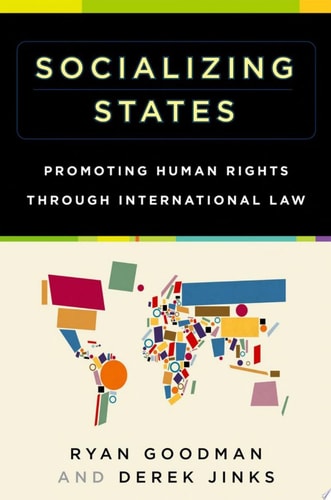
Socializing States: Promoting Human Rights through International Law
0
0
As an Amazon Associate and affiliate partner, Menrva Books earns from qualifying purchases. Learn more
Author Description
The role of international law in global politics is as poorly understood as it is important. But how can the international legal regime encourage states to respect human rights? Given that international law lacks a centralized enforcement mechanism, it is not obvious how this law matters at all, and how it might change the behavior or preferences of state actors. In Socializing States, Ryan Goodman and Derek Jinks contend that what is needed is a greater emphasis on the mechanisms of law's social influence--and the micro-processes that drive each mechanism. Such an emphasis would make clearer the micro-foundations of international law. This book argues for a greater specification and a more comprehensive inventory of how international law influences relevant actors to improve human rights conditions. Substantial empirical evidence suggests three conceptually distinct mechanisms whereby states and institutions might influence the behavior of other states: material inducement, persuasion, and what Goodman and Jinks call acculturation. The latter includes social and cognitive forces such as mimicry, status maximization, prestige, and identification. The book argues that (1) acculturation is a conceptually distinct, empirically documented social process through which state behavior is influenced; and (2) acculturation-based approaches might occasion a rethinking of fundamental regime design problems in human rights law. This exercise not only allows for reexamination of policy debates in human rights law; it also provides a conceptual framework for assessing the costs and benefits of various design principles. While acculturation is not necessarily the most important or most desirable approach to promoting human rights, a better understanding of all three mechanisms is a necessary first step in the development of an integrated theory of international law's influence. Socializing States provides the critical framework to improve our understanding of how norms operate in
Menrva's Summary
THE THESIS
How can international law effectively influence state behavior and promote human rights in the absence of a centralized enforcement mechanism? Ryan Goodman and Derek Jinks, both scholars of international law and human rights, argue that the influence of international law is best understood through the micro-processes of social influence. They propose an integrated framework that moves beyond traditional enforcement models to examine how states are socialized into compliance through material inducement, persuasion, and acculturation.
THE SCOPE MAP
What You Will Find
- A tripartite framework of social influence: material inducement, persuasion, and acculturation.
- Analysis of cognitive and social forces including mimicry, status maximization, and prestige.
- Theoretical applications for regime design in international human rights law.
Scope Limits
- The text does not provide an exhaustive history of every international human rights treaty.
- It does not offer a definitive ranking of which mechanism is most effective in every geopolitical context.
THE AUTHORITY PERSPECTIVE
Scholars and practitioners in international relations frequently cite this work as a foundational text for understanding the sociological dimensions of legal compliance. Readers often note the academic density of the prose, which is intended for an audience of legal theorists and political scientists.
Page Count:
256
Publication Date:
2013-01-01
Publisher:
Oxford University Press
ISBN-10:
0190203250
ISBN-13:
9780190203252
Sociology
International relations
Professional Career & Trade
International Law
Human rights
State The
Community Tags
Other Editions(2)

Similar Books











Reader Comments
Share Your Thoughts
No comments yet. Be the first to share your thoughts!