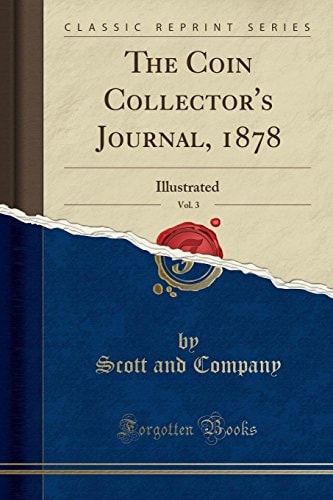
The Coin Collector's Journal, 1878, Vol. 3 Illustrated (Classic Reprint)
0
0
As an Amazon Associate and affiliate partner, Menrva Books earns from qualifying purchases. Learn more
Author Description
Excerpt from The Coin Collector's Journal, 1878, Vol. 3: Illustrated The aggressive tendencies of the Irish were now diverted into a chan nel far more glorious than that of military enterprise. About the year 430 A. D. St. Patrick, a native of' the little town of old Kilpatrick, near Glasgow, crossed the Channel and commenced his work as a Christian missionary. After great labor and exposure to many dangers, he suc ceeded in turning the people from their heathenism, and leading them to embrace the doctrines he taught, though not until, perhaps, a century after his death was Christianity accepted by all the people. At this date Ireland seems to have been occupied by a number of clans, or tribes, ruled over by chiefs, or petty kings, all of whom were feudally subject to a supreme monarch living at Tara, in Meath. In fact, the form of government was almost a counterpart of our own, ex cept that the offices of the monarch and of the kings, which we may con sider as analogous to those Of our own President and State Governors, were hereditary and not elective, a circumstance that did not preclude an occasional deposing of a ruler or of his dynasty, if the tribesmen were dissatisfied. At this period the attainments of the Irish people in general civilization and culture were very considerable. Each kingdom, or state, had its local laws, while the legislation of the monarchy, or union, was provided for by the Bretons, or class of professional jurists, who were held in high honor, and whose writings are on many points still de servedly esteemed. Gold seems to have been exceedingly abundant, judging from the large quantity of ornaments made from that metal that have been found throughout the island. About the Publisher Forgotten Books publishes hundreds of thousands of rare and classic books. Find more at www.forgottenbooks.com This book is a reproduction of an important historical work. Forgotten Books uses state-of-the-art technology to digitally reconstruct
Menrva's Summary
THE THESIS
This volume delves into the historical and cultural landscape of Ireland around 430 A.D., focusing on the arrival of Christianity and the prevailing societal structures. The text examines the missionary work of St. Patrick, detailing his efforts to convert the populace from paganism and the eventual, albeit delayed, acceptance of Christian doctrines. It further describes the political organization of Ireland, characterized by a system of clans, petty kings, and a supreme monarch at Tara, drawing parallels to contemporary governance while noting the hereditary nature of leadership. The author highlights the significant advancements in civilization and culture among the Irish people, including their legal systems and the esteemed status of jurists, as well as the abundance of gold indicated by archaeological finds.
THE SCOPE MAP
- Detailed account of St. Patrick's missionary activities in Ireland.
- Exploration of Ireland's political structure, including clans, petty kings, and a supreme monarch.
- Analysis of the hereditary nature of Irish leadership and the potential for deposing rulers.
- Discussion of the general civilization and culture of the Irish people during this period.
- Examination of the local and monarchical legal systems and the role of jurists.
- Evidence of abundant gold resources through the discovery of numerous gold ornaments.
THE AUTHORITY PERSPECTIVE
This reprinted volume, originating from 'The Coin Collector's Journal, 1878, Vol. 3', offers a historical perspective on early Irish society and the introduction of Christianity. The publisher, Forgotten Books, utilizes modern technology to reconstruct this historical work, making it accessible to a contemporary audience. The content focuses on historical narrative and societal analysis rather than numismatics, suggesting its value lies in its historical documentation. The excerpt provided indicates a scholarly approach to detailing the political and religious landscape of ancient Ireland.
Page Count:
250
Publication Date:
2017-10-29
Publisher:
Fb&c Limited
ISBN-10:
0266261906
ISBN-13:
9780266261902
Non-Fiction
History
Irish History
Christianity
Community Tags
Similar Books