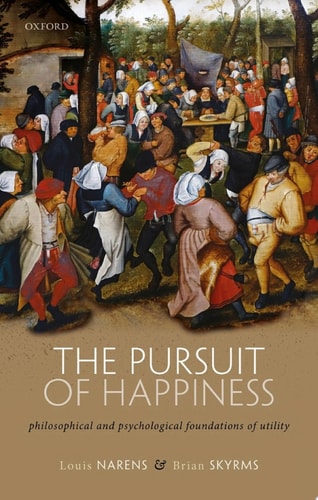
The Pursuit of Happiness: Philosophical and Psychological Foundations of Utility
0
0
As an Amazon Associate and affiliate partner, Menrva Books earns from qualifying purchases. Learn more
Author Description
Utilitarianism began as a movement for social reform that changed the world, based on the ideal of maximizing pleasure and minimizing pain. There is a tendency to enter into debates for and against the ethical doctrine of Utilitarianism without a clear understanding of its basic concepts. The Pursuit of Happiness now offers a rigorous account of the foundations of Utilitarianism, and vividly sets out possible ways forward for its future development. To understand Utilitarianism, we must understand utility: how is it to be measured, and how the aggregate utility of a group can be understood. Louis Narens and Brian Skyrms, respectively a cognitive scientist and a philosopher, pursue these questions by adopting both formal and historical methods, examining theories of measuring utility from Jeremy Bentham, the founder of the Utilitarian movement, to the present day, taking in psychophysics, positivism, measurement theory, meaningfulness, neuropsychology, representation theorems, and the dynamics of formation of conventions. On this basis, Narens and Skyrms argue that a meaningful form of Utilitarianism that can coordinate action in social groups is possible through interpersonal comparison and the formation of conventions.
Menrva's Summary
THE THESIS
This work investigates the foundational concepts of utility and the viability of Utilitarianism as a framework for social coordination. Louis Narens, a cognitive scientist, and Brian Skyrms, a philosopher, synthesize historical analysis with formal mathematical methods to evaluate how utility is measured and aggregated. By tracing the evolution of the doctrine from Jeremy Bentham to contemporary neuropsychology, the authors argue that a functional version of Utilitarianism is achievable through interpersonal comparison and the establishment of social conventions.
THE SCOPE MAP
What You Will Find
- Historical analysis of Utilitarian thought from Bentham to modern theory
- Application of measurement theory and psychophysics to ethical utility
- Examination of representation theorems and the dynamics of convention formation
- Integration of neuropsychological data into social utility models
Scope Limits
- Does not provide a comprehensive history of all ethical schools of thought
- Does not offer a prescriptive guide for individual moral decision-making
THE AUTHORITY PERSPECTIVE
Experts recognize this text as a rigorous interdisciplinary bridge between formal measurement theory and classical ethical philosophy. Readers frequently note the academic density of the prose, which requires a foundational understanding of logic and social science to fully grasp the authors' arguments.
Page Count:
208
Publication Date:
2020-01-01
Publisher:
OUP Oxford
ISBN-10:
0192598430
ISBN-13:
9780192598431
Philosophy
Psychology
Ethics
Utilitarianism
Measurement Theory
Social Science
Community Tags
Similar Books