Author Description
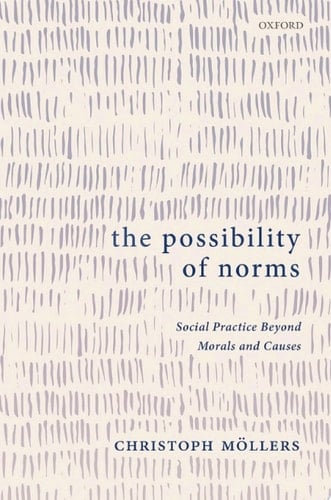
What defines the social practices we currently call norms? They make theft forbidden, eating with a fork advisable, and paintings beautiful. Norms are commonly thought of as moral justifications for doing one thing and not doing another. They are also described in terms of their outcomes or effects, serving as mere causal explanations. The Possibility of Norms proposes a broader view of how norms function, how they are articulated, and how they are realized. It may be asking too much if we expect norms to be effective or morally right. Many norms are simply ineffective and many are at most ineffectively justifiable. Drawing upon a rich array of texts - from law and jurisprudence to philosophy, aesthetics, and the social sciences - Möllers argues for conceiving of social norms as positively marked possibilities. Positively marking a possibility indicates that it should be realized. Normativity thus hinges on judging the world from a distance and acknowledging the possibility of divergent states of the world. Hence, it is no longer theoretically problematic that there are morally unjustified norms, nor that norms can be broken. On the contrary, allowing for breaches may be an important feature of normativity. Möllers's conceptual study sheds new light on a range of paradigms in the humanities, social sciences, and cultural studies, reframing several aspects of norm theory and questioning the theoretical assumptions underlying existing empirical work on normativity.
Page Count:
336
Publication Date:
2020-01-01
ISBN-10:
0192596039
ISBN-13:
9780192596031
Professional Career & Trade