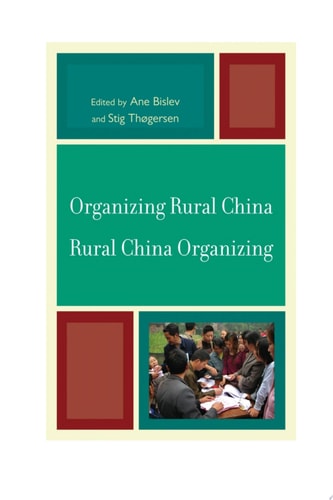
Organizing Rural China: Rural China Organizing
0
0
As an Amazon Associate and affiliate partner, Menrva Books earns from qualifying purchases. Learn more
Author Description
During the early 1980s China embarked on what can be seen as one of the world’s largest social experiments ever. Decollectivization meant much more than the reorganization of agricultural production into family based farming. It signaled significant changes to rural social relations, when privatization, marketization and increased geographical mobility started tearing apart the economic and social institutions that had structured collective village life under Mao. The focus of this book is on how rural society has been reorganized in the 21st century. The first chapters outline the basic organizational structure of rural China and can be used as an introduction to the topic in a classroom setting. They show how the state and its social scientists draw up plans to overcome the perceived lack of rural social organization, and discuss the often problem-ridden implementation of their ideas. The second section presents case studies of institutions that organize key aspects of rural life: Boarding schools where rural children learn to accept organizational hierarchies; lineage organizations carving out new roles for themselves; “dragonhead enterprises” expected to organize agricultural production and support rural development, and several others. The book is of theoretical interest because of its focus on the re-embedding, or reintegration, of individuals into new types of collectivities, which are less predetermined by tradition and habit and more a matter of, at least perceived, individual choice. Most chapters are based on extensive fieldwork and contain vivid examples from daily life, which will make the book attractive to anyone who wants to understand how Chinese villagers experience the extraordinary social changes they are going through.
Menrva's Summary
THE THESIS
This book investigates the complex processes of rural social reorganization in 21st-century China following the decollectivization reforms of the early 1980s. It examines how the state and its social scientists plan and implement strategies to address perceived deficiencies in rural social organization, often encountering significant challenges. The work explores the re-embedding of individuals into new collectivities that are increasingly based on perceived choice rather than tradition, drawing on extensive fieldwork and vivid examples from daily life to illustrate the experiences of Chinese villagers navigating these profound social transformations.
THE SCOPE MAP
- Analysis of the basic organizational structure of rural China as an introduction to the topic.
- Examination of state plans and social scientists' strategies for rural social organization.
- Case studies of institutions organizing key aspects of rural life, including boarding schools.
- Exploration of lineage organizations and their evolving roles in rural society.
- In-depth look at "dragonhead enterprises" and their function in organizing agricultural production and rural development.
- Theoretical discussion on the re-embedding of individuals into new, choice-driven collectivities.
- Presentation of extensive fieldwork and vivid examples from daily life in rural China.
THE AUTHORITY PERSPECTIVE
The book offers a detailed examination of rural China's social and organizational shifts in the 21st century, building upon the decollectivization reforms of the previous decades. Its structure, with introductory chapters followed by specific case studies, suggests a pedagogical approach suitable for classroom settings, while the theoretical focus on re-embedding individuals into new social structures provides academic depth. The reliance on extensive fieldwork and real-life examples indicates a rich, grounded analysis of how villagers experience these changes. The work is likely to be of interest to scholars of Chinese society, rural development, and sociology.
Page Count:
240
Publication Date:
2012-04-05
Publisher:
Bloomsbury Publishing PLC
ISBN-10:
0739170090
ISBN-13:
9780739170090
Politics
History
Non-Fiction
Anthropology
China Studies
Social change
Sociology
Community Tags
Similar Books