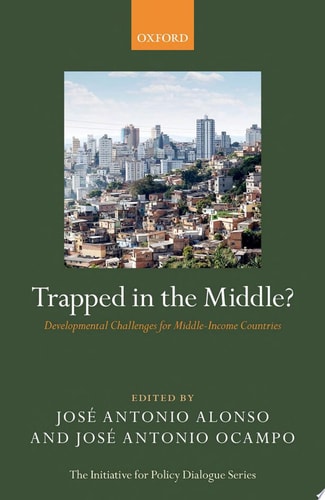
Trapped in the Middle?: Developmental Challenges for Middle-income Countries
0
0
As an Amazon Associate and affiliate partner, Menrva Books earns from qualifying purchases. Learn more
Author Description
Cover -- Trapped In The Middle?: Developmental Challenges For Middle-income Countries -- Copyright -- Contents -- List Of Figures -- List Of Tables -- List Of Acronyms -- List Of Editors And Contributors -- Editors -- Contributors -- 1: Economic Traps And Progress In Middle-income Countries: An Introduction -- 1.1 Convergence And Divergence In The International System -- 1.2 Two Preliminary Conceptual Precisions -- 1.2.1 Middle-income: Absolute Or Relative? -- 1.2.2 The Nature Of Mits -- 1.3 Empirical Evidence -- 1.3.1 Transit Between Groups -- 1.3.2 Relative Convergence 1.4 In Search Of Explanations -- 1.5 Policy Responses -- 1.6 Structure Of The Book -- 1.7 Acknowledgments -- References -- 2: Growth Strategies To Avoid The Middle-income Trap -- 2.1 Introduction -- 2.2 The Middle-income Trap: A Brief Review Of Empirical Evidence -- 2.3 Three Facts About Why Middle-income Countries Are Different -- 2.3.1 Convergence -- 2.3.2 Parameter Heterogeneity -- 2.3.3 Transition Dynamics: The Dominance Of Total Factor Productivity -- 2.4 A Short Guide To Successful Middle-income Transitions -- 2.4.1 A Theory Of Middle-income Country Growth 2.4.1.1 Competition Policy And Investment -- 2.4.1.2 Crisis Management And Institutional Change -- 2.4.1.3 Social Mobility, Entrepreneurship, And Innovation -- 2.4.2 The Practitioner's Perspective -- 2.5 Concluding Thoughts -- 2.6 Acknowledgment -- References -- 3: Innovation And The Three Detours For Economic Growth Beyond The Middle-income Stage -- 3.1 Introduction -- 3.2 Detour One: From Imitative To Innovation -- 3.3 Detour Two: More, Less, And More Gvc Again -- 3.4 Detour Three: From Short-cycle To Long-cycle Technologies -- 3.5 Summary And Concluding Remarks -- 3.6 Acknowledgments 5: Centripetal Politics And Institution Building In Exiting The Middle-income Trap -- 5.1 Introduction -- 5.2 Disarticulation Politics As Obstacles To Institution Building -- 5.3 Taxation: Truncated State Building -- 5.4 Quality Infrastructure I: Cohesion And
Menrva's Summary
THE THESIS
This volume investigates the structural and institutional barriers that prevent middle-income countries from transitioning into high-income status, a phenomenon commonly referred to as the middle-income trap. Edited by José Antonio Alonso and José Antonio Ocampo, the book synthesizes contributions from various economists to analyze why certain nations stagnate while others successfully navigate the transition. The authors argue that overcoming this trap requires a multifaceted approach involving innovation, institutional reform, and strategic economic policy rather than reliance on low-cost labor advantages.
THE SCOPE MAP
What You Will Find
- Empirical analysis of convergence and divergence patterns in the global economic system.
- Theoretical frameworks for growth strategies, including competition policy and crisis management.
- Examination of the role of innovation, technology cycles, and global value chains in economic development.
- Discussion on the intersection of political stability, taxation, and state-building.
Scope Limits
- The text focuses primarily on macroeconomic and institutional factors, excluding detailed micro-level case studies of specific individual corporations.
- It does not provide a universal blueprint for all nations, acknowledging the heterogeneity of middle-income country experiences.
THE AUTHORITY PERSPECTIVE
Experts and academics in the field of development economics recognize this work as a rigorous examination of the middle-income trap. Readers frequently note the academic density of the prose, making it a valuable resource for policymakers and graduate-level students interested in structural economic transformation.
Page Count:
320
Publication Date:
2020-01-01
Publisher:
Oxford University Press,
ISBN-10:
0192594230
ISBN-13:
9780192594235
Economics
Income
Global Finance
International relations
Public Policy
Community Tags
Other Editions(2)

Similar Books










Reader Comments
Share Your Thoughts
No comments yet. Be the first to share your thoughts!