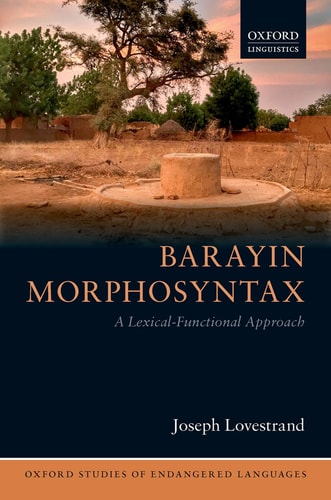
Barayin Morphosyntax: A Lexical-Functional Approach
0
0
As an Amazon Associate and affiliate partner, Menrva Books earns from qualifying purchases. Learn more
Author Description
This volume offers a Lexical-Functional Grammar (LFG) analysis of the morphosyntax of Barayin, a Chadic language spoken by about 6000 people in the Guera region of Chad. The core chapters of the book draw on rich empirical data to provide analyses of the basic clause, noun phrases, verb phrases, and serial verb constructions. The version of LFG adopted here includes two recent innovations: the first is minimal c-structure, which results in simpler phrase structure representations; the second is the assumption that glue semantics accounts for argument selection, rejecting the need for a level of a-structure or for Completeness and Coherence in f-structure. Argument sharing in serial verb constructions can thus be modeled in a connected s-structure. This method of modeling semantic composition in complex predicates is extended to directional and associated motion complex predicates in Choctaw and Wambaya, removing the need to appeal to a special mechanism to unite semantic forms in such constructions.
Menrva's Summary
THE THESIS
This volume investigates the morphosyntactic structure of the Barayin language through the specific theoretical framework of Lexical-Functional Grammar (LFG). Joseph Lovestrand utilizes empirical data collected from the Chadic-speaking population in the Guera region of Chad to test and refine LFG models. The author argues for the integration of minimal c-structure and glue semantics to streamline the representation of argument selection and complex predicates, effectively proposing a more efficient model for linguistic analysis.
THE SCOPE MAP
What You Will Find
- Detailed analysis of Barayin clause structure, noun phrases, and verb phrases.
- Application of minimal c-structure and glue semantics to serial verb constructions.
- Comparative analysis of directional and associated motion predicates in Choctaw and Wambaya.
Scope Limits
- The study is limited to the morphosyntactic features of Barayin and does not provide a comprehensive phonological or sociolinguistic survey of the language.
- The theoretical discussion is restricted to the LFG framework and does not engage in extensive comparative analysis with other generative or functionalist theories.
THE AUTHORITY PERSPECTIVE
Linguists and researchers in the field of syntax recognize this work as a specialized contribution to the study of Chadic languages and the evolution of LFG methodology. Readers frequently note the technical density of the prose, which is intended for an audience familiar with formal linguistic theory and syntactic modeling.
Page Count:
336
Publication Date:
2022-01-01
Publisher:
OUP Oxford
ISBN-10:
0192591835
ISBN-13:
9780192591838
English
Functional Grammar
Linguistics
Academic
Morphosyntax
Grammar
English & College Success
Chadic Languages