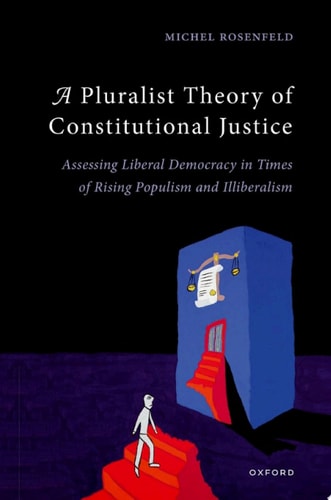
A Pluralist Theory of Constitutional Justice: Assessing Liberal Democracy in Times of Rising Populism and Illiberalism
0
0
As an Amazon Associate and affiliate partner, Menrva Books earns from qualifying purchases. Learn more
Author Description
In recent years, liberal constitutionalism has come under sharp attack. Globalization has caused huge disparities in wealth, identity-based alienation triggered by mass migration, and accompanying erosions of democracy. Liberal populists have also adapted the framework of liberal institutionalism, masking their aim to subvert its core values. These developments bring the links between justice and the constitution to the fore, particularly concerning distributive justice in its three dimensions of redistribution, recognition, and representation.A Pluralist Theory of Constitutional Justice provides a systematic account of the central role of distributive justice in the normative legitimation of liberal constitutions. The requirements of distributive justice are highly contested, and constitutions are susceptible to influencing those they govern. By drawing on Rawls' insight that distributive justice calls for "constitutional essentials", Rosenfeld advances the thesis that liberal constitutions must incorporate certain "justice essentials".This book is divided into three sections. Part one examines the current legal, economic, political and ideological developments that pose challenges to the normative viability of liberal constitutionalism. Part two offers a rereading of philosophical and jurisprudential literature that sheds crucial light on the relationship between constitution and justice. Finally, part three makes a case for using a thoroughly pluralistic approach in the quest for a constitution's justice essentials.
Menrva's Summary
THE THESIS
This book investigates how liberal constitutionalism can maintain normative legitimacy in the face of rising populism and illiberalism by integrating distributive justice into the constitutional framework. Michael J. Rosenfeld, a scholar of law and philosophy, utilizes a multidisciplinary approach to analyze the intersection of legal theory, economics, and political ideology. He argues that to survive current global challenges, liberal constitutions must move beyond procedural norms to incorporate specific 'justice essentials' that address redistribution, recognition, and representation. By synthesizing Rawlsian theory with contemporary political realities, the author provides a framework for re-evaluating the relationship between constitutional structure and social justice.
THE SCOPE MAP
What You Will Find
- Analysis of the three dimensions of distributive justice: redistribution, recognition, and representation.
- A critical examination of how populists manipulate liberal institutional frameworks to subvert democratic values.
- A philosophical rereading of jurisprudential literature regarding the normative viability of constitutions.
- A proposed pluralistic methodology for identifying and implementing 'justice essentials' within a constitutional system.
Scope Limits
- The text does not provide a comprehensive history of all global constitutional models.
- It does not offer specific legislative policy prescriptions for individual nations.
THE AUTHORITY PERSPECTIVE
Legal scholars and political theorists frequently cite this work as a rigorous contribution to the ongoing debate regarding the stability of liberal democracy. Readers often note the academic density of the prose, which requires a foundational understanding of constitutional law and political philosophy to fully navigate the author's arguments.
Page Count:
319
Publication Date:
2022-01-01
Publisher:
OUP Oxford
ISBN-10:
0192607375
ISBN-13:
9780192607379
Philosophy
Jurisprudence
Liberalism
Professional Career & Trade
Democracy
Constitutional Law
Community Tags
Similar Books