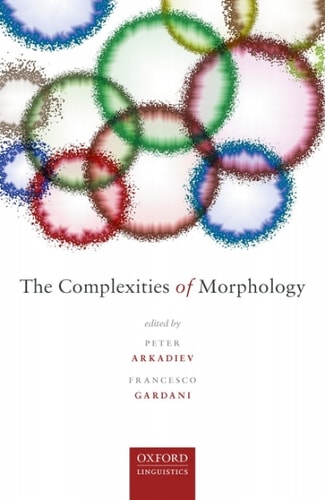
The Complexities of Morphology
0
0
As an Amazon Associate and affiliate partner, Menrva Books earns from qualifying purchases. Learn more
Author Description
This volume explores the multiple aspects of morphological complexity, investigating primarily whether certain aspects of morphology can be considered more complex than others, and how that complexity can be measured. The book opens with a detailed introduction from the editors that critically assesses the foundational assumptions that inform contemporary approaches to morphological complexity. In the chapters that follow, the volume's expert contributors approach the topic from typological, acquisitional, sociolinguistic, and diachronic perspectives; the concluding chapter offers an overview of these various approaches, with a focus on the minimum description length principle. The analyses are based on rich empirical data from both well-known languages such as Russian and lesser-studied languages from Africa, Australia, and the Americas, as well as experimental data from artificial language learning.
Menrva's Summary
THE THESIS
This volume investigates whether specific dimensions of morphological complexity can be objectively measured and compared across diverse linguistic systems. The editors, Francesco Gardani and Peter Arkadiev, curate a collection of expert contributions that challenge foundational assumptions in contemporary linguistics. By integrating typological, diachronic, and acquisitional frameworks, the text provides a rigorous methodology for evaluating how complexity manifests in both natural and artificial languages.
THE SCOPE MAP
What You Will Find
- Comparative analysis of morphological complexity across global language families.
- Application of the minimum description length principle to linguistic data.
- Integration of experimental data from artificial language learning studies.
- Sociolinguistic and diachronic perspectives on morphological evolution.
Scope Limits
- The text does not provide a comprehensive survey of all existing morphological theories.
- It does not focus on syntax or phonology except where they intersect directly with morphological complexity.
THE AUTHORITY PERSPECTIVE
Experts recognize this volume as a significant contribution to the formal study of linguistic complexity. Readers frequently note the academic density of the prose, which is intended for advanced students and professional linguists.
Page Count:
416
Publication Date:
2020-01-01
Publisher:
OUP Oxford
ISBN-10:
0192605518
ISBN-13:
9780192605511
English
English & College Success
Linguistics
Academic
Typology
Morphology