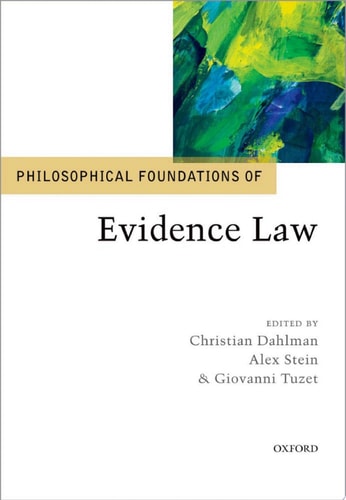
Philosophical Foundations of Evidence Law
0
0
As an Amazon Associate and affiliate partner, Menrva Books earns from qualifying purchases. Learn more
Author Description
Philosophy has a strong presence in evidence law and the nature of evidence is a highly debated topic in both general and social epistemology; legal theorists working in the evidence law area draw on different underlying philosophical theories of knowledge, inference and probability. Core evidentiary concepts and principles, such as the presumption of innocence, standards of proof, and others, reply on moral and political philosophy for their understanding and interpretation. Written by leading scholars across the globe, this volume brings together philosophical debates on the nature and function of evidence, proof, and law of evidence. It presents a cross-disciplinary overview of central issues in the theory and methodology of legal evidence and covers a wide range of contemporary debates on topics such as truth, proof, economics, gender, and race. The volume covers different theoretical approaches to legal evidence, including the Bayesian approach, scenario theory and inference to the best explanation. Divided in to five parts, Philosophical Foundations of Evidence Law, covers different theoretical approaches to legal evidence, including the Bayesian approach, scenario theory and inference to the best explanation.
Menrva's Summary
THE THESIS
This volume investigates the intersection of epistemology, moral philosophy, and political theory to define the foundational principles governing legal evidence. The editors, Alex M. Stein, Christian Dahlman, and Giovanni Tuzet, curate a collection of essays from international scholars to examine how theories of knowledge, probability, and inference shape the practical application of evidence law. The text argues that evidentiary concepts like the presumption of innocence and standards of proof are not merely procedural, but are deeply rooted in philosophical frameworks.
THE SCOPE MAP
What You Will Find
- Analysis of Bayesian approaches, scenario theory, and inference to the best explanation.
- Examination of the role of moral and political philosophy in legal interpretation.
- Discussions on the impact of economics, gender, and race on evidentiary standards.
Scope Limits
- The text does not provide a practical handbook for courtroom litigation or trial advocacy.
- It does not cover specific jurisdictional statutes or regional case law variations.
THE AUTHORITY PERSPECTIVE
Experts identify this volume as a comprehensive resource for legal theorists and philosophers interested in the epistemological underpinnings of the courtroom. Readers frequently note the academic density of the prose, which is intended for an audience familiar with advanced legal and philosophical discourse.
Page Count:
425
Publication Date:
2021-01-01
Publisher:
OUP Oxford
ISBN-10:
0192603094
ISBN-13:
9780192603098
Philosophy
Legal Theory
Evidence Law
Law
Professional Career & Trade
Epistemology
Community Tags
Similar Books