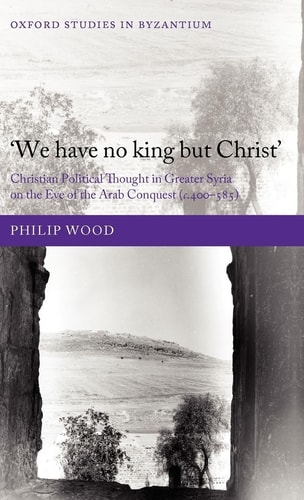
We Have No King but Christ: Christian Political Thought in Greater Syria on the Eve of the Arab Conquest (c.400-585)
0
0
As an Amazon Associate and affiliate partner, Menrva Books earns from qualifying purchases. Learn more
Author Description
Drawing on little-used sources in Syriac, once the lingua franca of the Middle East, Philip Wood examines how, at the close of the Roman Empire, Christianity carried with it new foundation myths for the peoples of the Near East that transformed their self-identity and their relationships with their rulers. This cultural independence was followed by a more radical political philosophy that dared to criticize the emperor and laid the seeds for the blending of religious and ethnic identity that we see in the Middle East today.
Menrva's Summary
THE THESIS
This work investigates how Christian political thought in Greater Syria during the late Roman period established new foundations for identity and governance that challenged imperial authority. Philip Wood, a specialist in late antique and Syriac studies, utilizes under-examined Syriac-language primary sources to reconstruct the intellectual climate of the Near East. He argues that these communities developed a distinct political philosophy that prioritized religious identity over imperial loyalty, ultimately influencing the long-term socio-political trajectory of the region.
THE SCOPE MAP
What You Will Find
- Analysis of Syriac-language primary sources and ecclesiastical texts from the 5th and 6th centuries.
- Examination of the transition from Roman imperial identity to localized Christian ethnic and religious identity.
- Case studies on the critique of imperial power by religious leaders in Greater Syria.
- Exploration of the ideological precursors to the political structures observed in the pre-Islamic Near East.
THE AUTHORITY PERSPECTIVE
Scholars recognize this text as a significant contribution to the study of Syriac Christianity and its role in late antique political discourse. Readers frequently note the academic density of the prose and the author's meticulous use of linguistic evidence to challenge traditional narratives of the Roman Empire.
Page Count:
350
Publication Date:
2011-01-29
Publisher:
Oxford University Press
ISBN-10:
019958849X
ISBN-13:
9780199588497
History
Religion
Christianity
Byzantine History
Community Tags
Similar Books