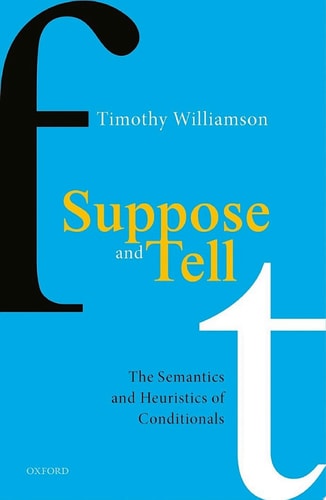
Suppose and Tell: The Semantics and Heuristics of Conditionals
0
0
As an Amazon Associate and affiliate partner, Menrva Books earns from qualifying purchases. Learn more
Author Description
What does 'if' mean? It is one of the most commonly used words in the English language, in itself a sign to the importance of conditional thinking to human cognitive life. We make conditional statements, ask conditional questions, and issue conditional orders. We need to think and talk conditionally for many purposes, from everyday decision-making to mathematical proof. Yet the meaning of conditionals has been debated for thousands of years. Suppose and Tell brings together ideas from philosophy, linguistics, and psychology to present a controversial new approach to understanding conditionals. It argues that in using 'if' we rely on psychological heuristics, methods which are fast and frugal and mostly, but not always, reliable. As a result philosophers and linguists have been led astray in theorizing about conditionals through trusting faulty data generated by such methods and prematurely rejecting simple theories on the basis of merely apparent counterexamples. Williamson shows how one such simple theory of conditionals can explain the data, and draws wider implications for the nature of meaning and its non-transparency to native speakers, vagueness in thought and language, and the need for semantics to attend to the unreliable heuristics underlying our judgments.
Menrva's Summary
THE THESIS
This book investigates the semantic meaning of the word 'if' and the psychological heuristics that govern human conditional reasoning. Timothy Williamson, a prominent philosopher of logic and language, utilizes a synthesis of linguistic theory, philosophical analysis, and cognitive psychology to argue that human reliance on fast and frugal heuristics often leads to flawed judgments about conditional statements. He contends that many long-standing debates in philosophy and linguistics stem from a failure to recognize these cognitive shortcuts, proposing that a simpler semantic theory can account for the data when these heuristics are properly understood.
THE SCOPE MAP
What You Will Find
- A critical analysis of the semantics of conditional statements in natural language.
- An examination of psychological heuristics and their impact on linguistic judgment.
- A defense of a simplified semantic theory of conditionals against traditional counterexamples.
Scope Limits
- The text does not provide a comprehensive history of all conditional logic theories.
- It does not offer a practical guide for improving individual decision-making skills.
THE AUTHORITY PERSPECTIVE
Experts recognize this work as a significant contribution to the philosophy of language, particularly for its challenge to established semantic frameworks. Readers frequently note the academic density of the prose, which requires a strong background in formal logic and analytic philosophy to fully grasp the author's arguments.
Page Count:
286
Publication Date:
2020-01-01
Publisher:
OUP Oxford
ISBN-10:
0192604775
ISBN-13:
9780192604774
Philosophy
Mathematics - General
Linguistics
Logic
Semantics
Mathematics Statistics
Community Tags
Similar Books