Author Description
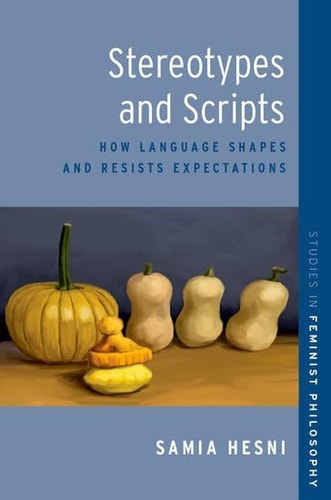
Generics are sentences that express generalizations about a particular group or kind: like "birds fly," "hikers love to snack," and "children are seen and not heard." A social script can be understood like an interpersonal dialogue, as with a script in a movie or play, that tells someone how to act in a given scenario: for example, saying "thank you" when receiving a compliment. A social script can also be a narrative about how one's life or behavior ought to go, or a set of expected generalizations and behaviors for a certain social role. On all conceptualizations, social scripts contribute to and reinforce biases and stereotypes. Generics, too, both describe and reinforce stereotypes about social kinds. Stereotypes and Scripts forges new ground by offering an interdisciplinary account of stereotypes, social scripts, and generics by identifying connections between language use and stereotyping, then drawing on those insights to provide linguistic strategies for resisting harmful stereotypes. Samia Hesni analyzes how we enact and express stereotypes through language: specifically social scripts and generics. Hesni draws out relations between stereotypes, scripts, and generics, and connects them to individual action and social change through script disruption and careful uses of counter-evidence and counter-examples. The book also outlines how features of scripts and generics can be used to resist and undermine harmful stereotypes. The lessons we draw from this can be applied to resist various kinds of harmful speech, as part of a broader project of identifying and cultivating language of resistance.
Menrva's Summary
THE THESIS
This book investigates how the linguistic structures of generics and social scripts function to encode, reinforce, and potentially dismantle harmful societal stereotypes. Samia Hesni, a philosopher of language, synthesizes concepts from linguistics and social theory to examine the mechanics of generalization. By analyzing how language shapes interpersonal expectations, the author provides a framework for understanding the relationship between speech patterns and social bias. The work ultimately argues for the strategic use of language to disrupt established scripts and resist oppressive stereotyping.
THE SCOPE MAP
What You Will Find
- Analysis of generics as linguistic tools for expressing group-based generalizations
- Conceptual frameworks for social scripts as interpersonal and narrative expectations
- Linguistic strategies for script disruption and the deployment of counter-evidence
- Interdisciplinary synthesis of philosophy, linguistics, and social activism
THE AUTHORITY PERSPECTIVE
Experts identify this work as a significant contribution to the philosophy of language and social epistemology. Readers frequently note the clarity with which the author bridges abstract linguistic theory with practical applications for social change.
Page Count:
160
Publication Date:
2025-07-11
Publisher:
Oxford University Press
ISBN-10:
0197769543
ISBN-13:
9780197769546
Philosophy
Politics & Social Sciences
Social Science
Language
Linguistics
Sociology
Communication
Community Tags
Similar Books