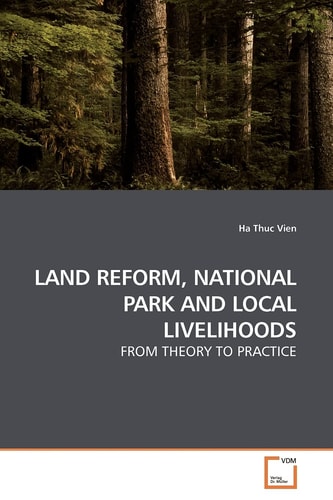
Land Reform, National Park and Local Livelihoods: From Theory to Practice
0
0
As an Amazon Associate and affiliate partner, Menrva Books earns from qualifying purchases. Learn more
Author Description
Recently, the Southern upland of Vietnam has rapidly transformed due to the implementation of a series of institutional reforms, natural conservation and development programs. Research findings show that in response to impacts of institutional reforms and development programs, local people have tended to diversify their livelihood strategies, but their patterns of livelihood diversification are various and highly dependent on their background and benefits gained from such policies. Moreover, villagers have also developed new coping strategies and long-term social engagements to respond to the unequal resource control and social differentiation. Losers - the poor have developed various forms of short-term resistance which may be either collective or individual and either open declaration or hidden transcripts. By contrast, the winners – the wealthy and powerful those who benefiting from such policies and related programs, have usually employed strategies of compromise and negotiation. In a long- term in everyday practice, local people have developed adaptive strategies, such as, rearrangementa of land tenure, social structure, social relations, and rearrangements of production.
Menrva's Summary
THE THESIS
This book investigates the complex interplay between land reform, national park establishment, and the livelihoods of local communities in Vietnam's Southern upland region. The research examines how institutional reforms and conservation programs have prompted local populations to diversify their strategies, with patterns varying based on individual backgrounds and policy benefits. It also details the adaptive mechanisms developed by villagers to navigate unequal resource control and social stratification, including resistance from the poor and negotiation from the wealthy.
THE SCOPE MAP
- Analysis of institutional reforms and their impact on local livelihoods.
- Examination of livelihood diversification strategies in response to policy changes.
- Study of new coping mechanisms and social engagements developed by villagers.
- Exploration of unequal resource control and social differentiation.
- Identification of resistance strategies employed by the poor (collective/individual, open/hidden).
- Analysis of compromise and negotiation strategies used by the wealthy and powerful.
- Discussion of long-term adaptive strategies, including rearrangements of land tenure, social structure, and production.
THE AUTHORITY PERSPECTIVE
The book offers a detailed examination of socio-economic changes in Vietnam's Southern uplands, focusing on the practical outcomes of land reform and conservation policies. It highlights the varied responses of local populations, from diversification to resistance and negotiation, based on their socio-economic standing. The research provides insights into the adaptive strategies communities develop to manage resource control and social differentiation. The work is likely to be of interest to scholars and policymakers concerned with rural development, conservation, and social change in Southeast Asia.
Page Count:
184
Publication Date:
2009-07-26
Publisher:
VDM Verlag Dr. Müller
ISBN-10:
3639148762
ISBN-13:
9783639148763
Non-Fiction
History
Economics
Vietnam
National Parks
Land Reform
Community Tags
Similar Books