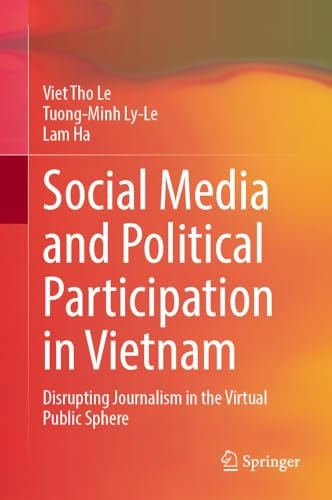
Social Media and Political Participation in Vietnam: Disrupting Journalism in the Virtual Public Sphere
0
0
As an Amazon Associate and affiliate partner, Menrva Books earns from qualifying purchases. Learn more
Author Description
This book explores the nexus between social media use among young people and political participation in Vietnam, which presents a novel case example for examining whether social media can expand the public sphere to become involved in everyday politics. With an estimated 72 million Vietnamese on Facebook, the country is the seventh-largest user base in the world. This social media platform alone has created a virtual public sphere outside of and beyond the scope of the ruling Communist Party and its state-owned media outlets. The authors analyse the paradox of a complicated balancing act of digital participation in an authoritarian state, promoting a new understanding of social media in non-Western societies. The book generates a considerable body of empirical findings relating to political engagement amongst the youth in the digital age, and develops the theory of the public sphere beyond Habermas within this context. In its examination of the role of social media in society and in political communication generally, and the role of social media in authoritarian states, specifically, this book is of interest to students and scholars researching social media, political communication, and media theories. It is also relevant to those studying the intersection of media and politics in Southeast Asia, and in authoritarian states globally.
Menrva's Summary
THE THESIS
This book investigates the complex relationship between social media use among young people and political participation in Vietnam, a nation with a significant online population and an authoritarian government. The authors examine how platforms like Facebook, used by millions of Vietnamese, create a virtual public sphere that operates beyond the control of the ruling Communist Party and its state-controlled media. They analyze the challenges and paradoxes of digital engagement within this restrictive environment, offering new insights into social media's role in non-Western societies and developing theoretical frameworks for the public sphere that extend beyond Habermas's original concepts.
THE SCOPE MAP
- Analysis of social media usage patterns among Vietnamese youth.
- Examination of political participation in an authoritarian context.
- Exploration of the concept of a virtual public sphere in Vietnam.
- Discussion of the role of social media in challenging state-controlled media.
- Empirical findings on youth political engagement in the digital age.
- Theoretical development of the public sphere beyond Habermas.
- Case study of social media's impact on politics in a non-Western society.
THE AUTHORITY PERSPECTIVE
The book is positioned as a significant contribution to understanding social media's role in political communication, particularly within authoritarian states and non-Western contexts. Its empirical findings on youth engagement in Vietnam are expected to inform academic research in media theory, political communication, and Southeast Asian studies. The work aims to provide a nuanced perspective on the balancing act of digital participation under restrictive regimes, offering a novel case study for broader theoretical discussions on the public sphere.
Page Count:
227
Publication Date:
2024-12-22
Publisher:
Springer Nature Singapore
ISBN-10:
9819789540
ISBN-13:
9789819789542
Politics
Non-Fiction
Science & Technology
Media Theory
Social Media
Community Tags
Similar Books