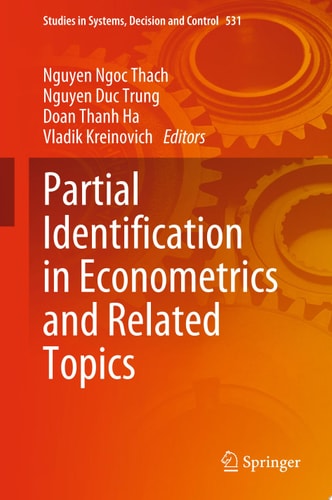
Partial Identification in Econometrics and Related Topics
0
0
As an Amazon Associate and affiliate partner, Menrva Books earns from qualifying purchases. Learn more
Author Description
This book covers data processing techniques, with economic and financial application being the unifying theme. To make proper investments in economy, the authors need to have a good understanding of the future trends: how will demand change, how will prices change, etc. In general, in science, the usual way to make predictions is: to identify a model that best fits the current dynamics, and to use this model to predict the future behavior. In many practical situations—especially in economics—our past experiences are limited. As a result, the authors can only achieve a partial identification. It is therefore important to be able to make predictions based on such partially identified models—which is the main focus of this book. This book emphasizes partial identification techniques, but it also describes and uses other econometric techniques, ranging from more traditional statistical techniques to more innovative ones such as game-theoretic approach, interval techniques, and machine learning. Applications range from general analysis of GDP growth, stock market, and consumer prices to analysis of specific sectors of economics (credit and banking, energy, health, labor, tourism, international trade) to specific issues affecting economy such as ecology, national culture, government regulations, and the existence of shadow economy. This book shows what has been achieved, but even more important are remaining open problems. The authors hope that this book will: inspire practitioners to learn how to apply state-of-the-art techniques, especially techniques of optimal transport statistics, to economic and financial problems, and inspire researchers to further improve the existing techniques and to come up with new techniques for studying economic and financial phenomena. The authors want to thank all the authors for their contributions and all anonymous referees for their thorough analysis and helpful comments. The publication of this book—and organization of the conference a
Menrva's Summary
THE THESIS
This book investigates the challenges and techniques of partial identification in econometrics, particularly when historical data is limited for economic and financial forecasting. The authors, Doan Thanh Ha, Nguyen Duc Trung, Nguyen Ngoc Thach, and Vladik Kreinovich, address the common scientific approach of using past data to predict future trends, highlighting that in economics, limited past experiences often result in only partial identification of models. The core focus is on developing and applying methods to make reliable predictions from these partially identified models, integrating various econometric techniques from traditional statistics to more advanced approaches like game theory, interval techniques, and machine learning.
THE SCOPE MAP
- Data processing techniques with a unifying theme of economic and financial applications.
- Methods for making predictions based on partially identified models due to limited past data.
- Coverage of traditional statistical techniques alongside innovative approaches such as game-theoretic methods, interval techniques, and machine learning.
- Applications ranging from general GDP growth, stock market, and consumer prices analysis.
- Specific sector analyses including credit and banking, energy, health, labor, tourism, and international trade.
- Exploration of issues affecting the economy such as ecology, national culture, government regulations, and the shadow economy.
- Discussion of remaining open problems and areas for future research in econometrics.
- Inspiration for practitioners to apply state-of-the-art techniques, including optimal transport statistics, to economic and financial problems.
THE AUTHORITY PERSPECTIVE
The book aims to equip practitioners with advanced techniques for economic and financial problems, particularly those involving partial identification. It also seeks to stimulate researchers to refine existing methods and develop new ones for economic phenomena. The authors acknowledge contributions from various individuals and anonymous referees, indicating a collaborative and peer-reviewed development process. The publication is intended to bridge the gap between theoretical advancements and practical application in econometrics.
Page Count:
735
Publication Date:
2024-07-31
Publisher:
Springer Nature
ISBN-10:
3031591100
ISBN-13:
9783031591105
Economics
Science
Non-Fiction
Machine Learning
Game theory
Statistics
Finance
Econometrics
Community Tags
Similar Books




Reader Comments
Share Your Thoughts
No comments yet. Be the first to share your thoughts!