Verification of Sequential and Concurrent Programs
0
0
As an Amazon Associate and affiliate partner, Menrva Books earns from qualifying purchases. Learn more
Author Description
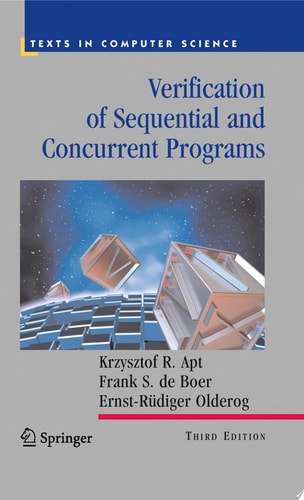
HIS BOOK CONTAINS a most comprehensive text that presents syntax-directed and compositional methods for the formal veri?- T cation of programs. The approach is not language-bounded in the sense that it covers a large variety of programming models and features that appear in most modern programming languages. It covers the classes of - quential and parallel, deterministic and non-deterministic, distributed and object-oriented programs. For each of the classes it presents the various c- teria of correctness that are relevant for these classes, such as interference freedom, deadlock freedom, and appropriate notions of liveness for parallel programs. Also, special proof rules appropriate for each class of programs are presented. In spite of this diversity due to the rich program classes cons- ered, there exist a uniform underlying theory of veri?cation which is synt- oriented and promotes compositional approaches to veri?cation, leading to scalability of the methods. The text strikes the proper balance between mathematical rigor and - dactic introduction of increasingly complex rules in an incremental manner, adequately supported by state-of-the-art examples. As a result it can serve as a textbook for a variety of courses on di?erent levels and varying durations. It can also serve as a reference book for researchers in the theory of veri?- tion, in particular since it contains much material that never before appeared in book form. This is specially true for the treatment of object-oriented p- grams which is entirely novel and is strikingly elegant.
Menrva's Summary
THE THESIS
This book presents syntax-directed and compositional methods for the formal verification of programs. It covers a wide variety of programming models and features found in modern languages, including sequential, parallel, deterministic, non-deterministic, distributed, and object-oriented programs. For each class, it details relevant correctness criteria like interference freedom, deadlock freedom, and liveness, along with specific proof rules. A uniform, syntax-oriented theory of verification underpins these methods, promoting compositional approaches for scalability.
THE SCOPE MAP
- Syntax-directed and compositional methods for program verification
- Coverage of sequential, parallel, deterministic, and non-deterministic programs
- Treatment of distributed and object-oriented programming models
- Discussion of correctness criteria: interference freedom, deadlock freedom, liveness
- Presentation of specialized proof rules for different program classes
- Uniform underlying theory of verification
- State-of-the-art examples supporting incremental rule introduction
- Novel and elegant treatment of object-oriented programs
THE AUTHORITY PERSPECTIVE
This comprehensive text is designed to serve as both a textbook for various courses and a reference for researchers in verification theory. Its approach balances mathematical rigor with a didactic introduction of complex rules, supported by examples. The inclusion of material not previously published in book form, particularly the novel treatment of object-oriented programs, enhances its value as a reference. The book's structured presentation and broad coverage make it a significant contribution to the field.
Page Count:
502
Publication Date:
2009-09-18
Publisher:
Springer Science & Business Media
ISBN-10:
1848827458
ISBN-13:
9781848827455
Science & Technology
Non-Fiction
Computer Science
Software Engineering
Formal Methods
Community Tags
Similar Books