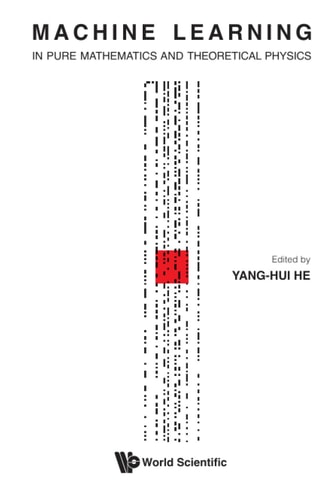
Machine Learning in Pure Mathematics and Theoretical Physics
0
0
As an Amazon Associate and affiliate partner, Menrva Books earns from qualifying purchases. Learn more
Author Description
The juxtaposition of 'machine learning' and 'pure mathematics and theoretical physics' may first appear as contradictory in terms. The rigours of proofs and derivations in the latter seem to reside in a different world from the randomness of data and statistics in the former. Yet, an often under-appreciated component of mathematical discovery, typically not presented in a final draft, is experimentation: both with ideas and with mathematical data. Think of the teenage Gauss, who conjectured the Prime Number Theorem by plotting the prime-counting function, many decades before complex analysis was formalized to offer a proof.Can modern technology in part mimic Gauss's intuition? The past five years saw an explosion of activity in using AI to assist the human mind in uncovering new mathematics: finding patterns, accelerating computations, and raising conjectures via the machine learning of pure, noiseless data. The aim of this book, a first of its kind, is to collect research and survey articles from experts in this emerging dialogue between theoretical mathematics and machine learning. It does not dwell on the well-known multitude of mathematical techniques in deep learning, but focuses on the reverse relationship: how machine learning helps with mathematics. Taking a panoramic approach, the topics range from combinatorics to number theory, and from geometry to quantum field theory and string theory. Aimed at PhD students as well as seasoned researchers, each self-contained chapter offers a glimpse of an exciting future of this symbiosis.
Menrva's Summary
THE THESIS
The book investigates the novel intersection of machine learning and theoretical mathematics and physics. It explores how artificial intelligence can aid in mathematical discovery, moving beyond traditional computational methods to uncover patterns, accelerate derivations, and generate conjectures from pure data. The work collects research and survey articles from experts, focusing on the reverse relationship where machine learning assists mathematics, rather than the more common focus on mathematical techniques within deep learning.
THE SCOPE MAP
- Research and survey articles from experts in the emerging dialogue between theoretical mathematics and machine learning.
- Focus on how machine learning assists mathematics, rather than mathematical techniques in deep learning.
- Topics ranging from combinatorics, number theory, and geometry to quantum field theory and string theory.
- Self-contained chapters offering insights into the symbiosis of AI and theoretical sciences.
- Content aimed at PhD students and seasoned researchers in the field.
THE AUTHORITY PERSPECTIVE
This book is positioned as a pioneering collection, aiming to bridge the gap between machine learning and theoretical mathematics and physics. The premise suggests a focus on the application of AI in aiding mathematical discovery, a relatively new area of research. It is intended for an advanced academic audience, including PhD students and researchers, indicating a potentially dense and specialized content.
Page Count:
420
Publication Date:
2023-01-01
Publisher:
World Scientific
ISBN-10:
1800613695
ISBN-13:
9781800613690
Science
Non-Fiction
Number Theory
String Theory
Geometry
Combinatorics
Theoretical Physics
Research
Pure Mathematics
Machine Learning
Community Tags
Other Editions(2)

Similar Books