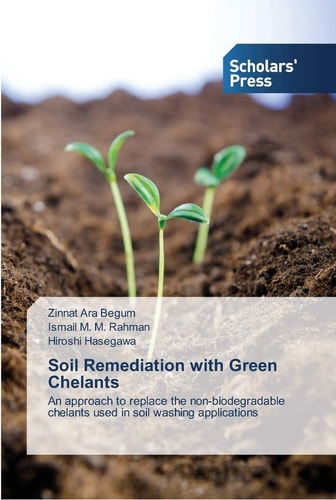
Soil Remediation with Green Chelants
0
0
As an Amazon Associate and affiliate partner, Menrva Books earns from qualifying purchases. Learn more
Author Description
Aminopolycarboxylate chelants (APCs) such as, EDTA and its homologs are commonly utilized in the ex situ washing remediation of the metal-contaminated soils due to their ability to interact with the majority of toxic elements. However, the eco-environmental consequences due to the release of APCs to the surroundings become an issue of concern, and increasingly stringent legislative regulations have been proposed or imposed to control the discharge of APCs. Therefore, replacement of classical APCs with eco-friendly biodegradable variants became a topic of interest. In a broad sense, the book is about a thorough evaluation of two new biodegradable APCs, namely DL-2-(2-carboxymethyl)nitrilo-triacetic acid (GLDA) and 3-hydroxy-2,2'-iminodisuccinic acid (HIDS), for the washing remediation of contaminated soils. The content includes discussion on the complexation properties of GLDA and HIDS with the divalent (Cd, Cu, Ni, Pb and Zn) and trivalent (Cr, Fe) ions, along with practical examples of the washing treatment of both naturally and artificially metal-contaminated reference soils with GLDA and HIDS. Besides, a comparative evaluation with other green chelants is included.
Menrva's Summary
THE THESIS
This book investigates the efficacy of novel biodegradable chelants for remediating metal-contaminated soils. The authors evaluate DL-2-(2-carboxymethyl)nitrilo-triacetic acid (GLDA) and 3-hydroxy-2,2'-iminodisuccinic acid (HIDS) as eco-friendly alternatives to traditional aminopolycarboxylate chelants (APCs) like EDTA. The research details the complexation properties of GLDA and HIDS with various divalent and trivalent metal ions, providing practical examples of their application in washing treatments of contaminated reference soils. A comparative analysis with other green chelants is also presented to contextualize their performance.
THE SCOPE MAP
- Evaluation of biodegradable chelants GLDA and HIDS for soil remediation.
- Analysis of complexation properties with divalent metal ions (Cd, Cu, Ni, Pb, Zn).
- Analysis of complexation properties with trivalent metal ions (Cr, Fe).
- Practical examples of washing treatment for naturally metal-contaminated soils.
- Practical examples of washing treatment for artificially metal-contaminated soils.
- Comparative evaluation with other green chelants.
- Discussion on the environmental concerns associated with traditional chelants like EDTA.
THE AUTHORITY PERSPECTIVE
The research presented in this book addresses the growing concern over the environmental impact of traditional chelants used in soil remediation. By focusing on biodegradable alternatives like GLDA and HIDS, the authors provide a thorough scientific evaluation of their effectiveness. The detailed analysis of complexation properties and practical application examples offers valuable insights for researchers and practitioners in environmental science and soil remediation. This work contributes to the development of more sustainable methods for cleaning contaminated land.
Page Count:
140
Publication Date:
2015-05-20
Publisher:
Scholars' Press
ISBN-10:
3639701429
ISBN-13:
9783639701425
Non-Fiction
Science
Soil Science
Chemistry
Community Tags
Similar Books