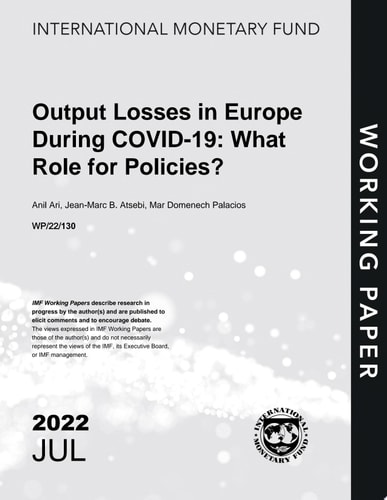
Output Losses in Europe During COVID-19: What Role for Policies?
0
0
As an Amazon Associate and affiliate partner, Menrva Books earns from qualifying purchases. Learn more
Author Description
We use a decomposition methodology to analyze the factors underlying the differentiated output losses of European countries in 2020. Our findings are fourfold: First, 2020 growth outcomes can be explained by differences in mobility, underlying growth trends, and pre-pandemic country fundamentals. Second, fiscal and monetary policies helped alleviate output losses during the pandemic in all European countries but to a varying extent. Third, shallower recessions in emerging market economies in Europe can be attributed to higher underlying growth and younger populations. Fourth, fiscal multipliers were higher in countries where above-the-line measures accounted for a larger share of the total fiscal package, the size of the total fiscal package was smaller, and inequality and informality were greater, as well as in countries with IMF-supported program during the pandemic.
Menrva's Summary
THE THESIS
This book investigates the varied economic impacts of the COVID-19 pandemic across European nations and the efficacy of policy responses. The authors employ a decomposition methodology to dissect the reasons behind the disparate output losses observed in 2020, considering factors such as mobility, pre-existing growth trends, and country-specific fundamentals. The analysis reveals that while fiscal and monetary policies provided a degree of mitigation, their effectiveness varied significantly across the continent. Furthermore, the study explores why emerging European economies fared better, attributing it to factors like higher underlying growth and younger demographics, and examines the conditions under which fiscal multipliers proved most potent.
THE SCOPE MAP
- Analysis of differentiated output losses in European countries during 2020.
- Decomposition methodology to identify underlying factors influencing growth outcomes.
- Examination of the role of mobility, underlying growth trends, and pre-pandemic country fundamentals.
- Assessment of the varying impact of fiscal and monetary policies in mitigating output losses.
- Comparison of recession depths in emerging market economies versus other European nations.
- Identification of factors influencing fiscal multipliers, including the composition of fiscal packages, country inequality, and informality.
- Consideration of the impact of IMF-supported programs during the pandemic.
THE AUTHORITY PERSPECTIVE
The analysis presented in this work offers a detailed examination of the economic consequences of the COVID-19 pandemic in Europe, focusing on the differential impacts across countries and the role of policy interventions. The findings suggest a complex interplay of factors, including mobility, pre-existing economic conditions, and demographic elements, in shaping national recessions. The study's breakdown of fiscal policy effectiveness and the conditions that amplify fiscal multipliers provides valuable insights for policymakers. This research contributes to a deeper understanding of the economic landscape shaped by the pandemic and the nuances of policy responses in diverse European economies.
Page Count:
39
Publication Date:
2022-07-01
Publisher:
International Monetary Fund
ISBN-13:
9798400215247
Politics
Non-Fiction
Economics
History
Community Tags
Similar Books