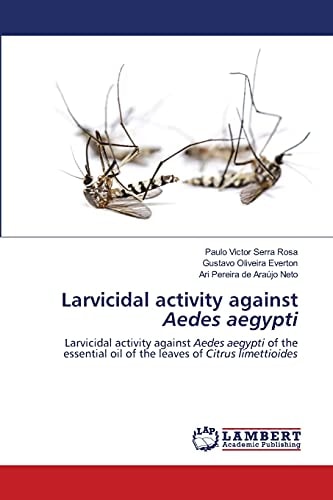
Larvicidal activity against Aedes aegypti: Larvicidal activity against Aedes aegypti of the essential oil of the leaves of Citrus limettioides
0
0
As an Amazon Associate and affiliate partner, Menrva Books earns from qualifying purchases. Learn more
Author Description
This study aimed to evaluate the chemical profile and the larvicidal activity of the essential oil (OE) of the leaves of Citrus limettioides Tanaka against the larvae of the mosquito Aedes aegypti. The OE was extracted by hydrodistillation at 100 ° C for 3h, with chemical characterization through gas chromatography coupled and mass spectrometry (CG-EM). In the toxicity test, Artemia salina Leach mortality for the action of essential oil was verified by the Reed & Muench method and the mortality of Aedes aegypti larvae by the Probit method. The toxicity test evaluated the lethality of OE compared to Aedes aegypti, obtaining an LC50 of199.5 mg L-1, being classified as moderately toxic. The larvicidal activity of the LE presented a LC50 of 30.45 mg L-1, classified as active. The results obtained indicate that the studied EO has chemical constituents that present satisfactory larvicidal activity, proving to be efficient in the combat and control of Aedes aegypti larvae.
Menrva's Summary
THE THESIS
This study investigates the larvicidal efficacy of essential oil extracted from Citrus limettioides leaves against Aedes aegypti mosquito larvae. The research details the hydrodistillation process for extracting the essential oil (OE) and its chemical characterization using gas chromatography coupled with mass spectrometry (GC-MS). Toxicity was assessed against Artemia salina and Aedes aegypti larvae, yielding an LC50 of 199.5 mg L-1 for the OE against Aedes aegypti, classifying it as moderately toxic, while the leaf extract (LE) showed a more potent LC50 of 30.45 mg L-1, indicating significant larvicidal activity.
THE SCOPE MAP
- Extraction of essential oil (OE) from Citrus limettioides leaves via hydrodistillation at 100°C for 3 hours.
- Chemical profiling of the OE using gas chromatography coupled with mass spectrometry (GC-MS).
- Toxicity assessment against Artemia salina Leach using the Reed & Muench method.
- Larvicidal activity evaluation against Aedes aegypti larvae using the Probit method.
- Determination of the LC50 value for the OE against Aedes aegypti larvae (199.5 mg L-1).
- Determination of the LC50 value for the leaf extract (LE) against Aedes aegypti larvae (30.45 mg L-1).
- Classification of the OE's toxicity as moderate.
- Classification of the LE's larvicidal activity as active.
THE AUTHORITY PERSPECTIVE
The study presents findings on the larvicidal activity of Citrus limettioides leaf essential oil against Aedes aegypti. The research details the methodology for oil extraction, chemical analysis, and toxicity testing, providing specific LC50 values for both the essential oil and leaf extract. The results indicate that the essential oil possesses chemical constituents that demonstrate satisfactory larvicidal activity, suggesting its potential efficiency in controlling Aedes aegypti larvae.
Page Count:
52
Publication Date:
2021-04-13
Publisher:
LAP LAMBERT Academic Publishing
ISBN-10:
6203840378
ISBN-13:
9786203840377
Non-Fiction
Science
Research
Public Health
Entomology
Community Tags
Similar Books