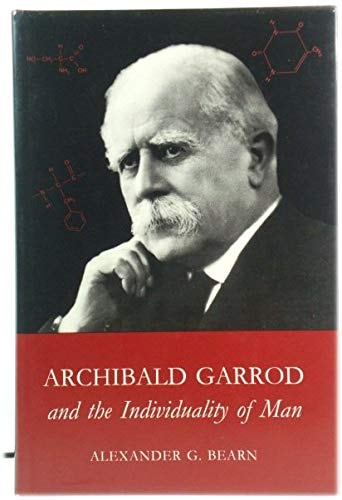
Archibald Garrod and the Individuality of Man
0
0
As an Amazon Associate and affiliate partner, Menrva Books earns from qualifying purchases. Learn more
Author Description
In this scholarly and insightful biography, Alexander G. Bearn, a physician and a scientist in the Garrodian tradition, has drawn a portrait of one of the great minds of twentieth century medicine. It is story of intellectual achievement. But the book also gives a fascinating account of the life of a talented professional family and a perspective on the practice of medicine and on medical education at the turn of the century. Archibald Garrod is chiefly remembered as the originator of the concept of inborn metabolic error, an idea which grew from his studies of families with diseases whose biochemical basis he was able to identify. He was widely recognized for this achievement in his own lifetime and held a respected position in the medical establishment, a position accorded to him on the basis of his scientific achievement rather than for any great clinical skill. But to concentrate on the concept of inborn errors is to overlook what has in time turned out to be Garrod's greatest achievement, for it was he who first saw that genetics, biochemistry, and medicine are fundamentally linked. He propounded, to all who would listen, his thesis that disease can only be properly studied in the light of an individual's genetic susceptibility, and that that in turn rests on biochemical individuality. Only by thinking of human diseases as the consequences of genetic and environmental interaction are the advances of today's and tomorrow's medicine possible.
Menrva's Summary
THE THESIS
This biography investigates the intellectual evolution of Archibald Garrod and his foundational role in bridging the disciplines of genetics, biochemistry, and clinical medicine. Alexander G. Bearn, a physician and scientist, utilizes his professional background to contextualize Garrod's work within the medical landscape of the early twentieth century. The text argues that Garrod's most significant contribution was not merely the identification of inborn metabolic errors, but the conceptual shift toward understanding disease as a product of individual genetic susceptibility and environmental interaction.
THE SCOPE MAP
What You Will Find
- Historical analysis of medical education and practice at the turn of the twentieth century
- Detailed examination of the development of the inborn metabolic error concept
- Biographical account of the Garrod family and their professional influence
Scope Limits
- The text does not provide a comprehensive clinical manual for modern metabolic disorders
- The narrative focus is primarily on the intellectual history of the subject rather than a exhaustive personal chronology
THE AUTHORITY PERSPECTIVE
Experts recognize this work as a definitive account of Garrod's contributions to the field of medical genetics. Readers frequently note the academic rigor of the prose, which effectively balances historical context with scientific explanation.
Page Count:
248
Publication Date:
1993-06-03
Publisher:
Oxford University Press
ISBN-10:
0192621459
ISBN-13:
9780192621450
Biography
Genetics
Science History
Medicine
Physicians biography
Biochemists
MEDICAL History
Community Tags
Similar Books