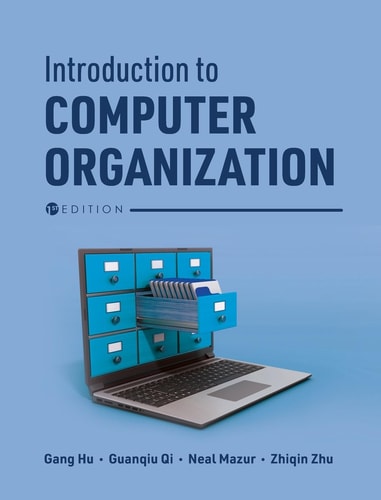
Introduction to Computer Organization
0
0
As an Amazon Associate and affiliate partner, Menrva Books earns from qualifying purchases. Learn more
Author Description
Introduction to Computer Organization equips students with foundational and essential knowledge regarding how computers process numbers and organize data. Opening chapters address computer numbering systems, signed integer representation, floating point representation, and character codes. Students learn about bitwise operations, Boolean function, Karnaugh maps, digital circuit design, and computer memory. Additional chapters cover central processing units (CPUs), I/O processing, and instruction set architecture. The closing chapter provides students with a simple 16-bit RISC instruction set for a CPU simulator, SimX system, furnishing them with a better understanding of the working mechanism of a computer system and preliminary knowledge of assembly programming. A helpful appendix provides students with a set of SimX utilities, including an assembler, a linker, and a combination of assembler and linker. Designed to provide students with a firm grasp of critical material in the field, Introduction to Computer Organization is an exemplary resource for courses and programs in computer science. Gang Hu is an assistant professor in the Department of Computer Information Systems at SUNY Buffalo State. He holds a Ph.D. in computer science from Dalhousie University. Guanqiu Qi is an assistant professor in the Department of Computer Information Systems at SUNY Buffalo State. He holds a Ph.D. in computer science from Arizona State University. Neal Mazur is an associate professor in the Department of Computer Information Systems at SUNY Buffalo State. He holds a Ph.D. in computer science from Arizona State University. Zhiqin Zhu is a professor in the College of Automation at Chongqing University of Post and Telecommunications, Chongqing. He holds a Ph.D. in control engineering from Chongqing University.
Menrva's Summary
THE THESIS
This book investigates the fundamental principles of how computers process numbers and organize data. It covers essential topics such as computer numbering systems, signed and floating-point representation, and character codes, progressing to bitwise operations, Boolean functions, and digital circuit design. The text also explores computer memory, central processing units (CPUs), I/O processing, and instruction set architecture, culminating in a practical 16-bit RISC instruction set for the SimX CPU simulator to illustrate assembly programming concepts.
THE SCOPE MAP
- Computer numbering systems and representation of numbers (signed integers, floating point).
- Character codes and their representation.
- Bitwise operations and Boolean functions, including Karnaugh maps.
- Digital circuit design principles.
- Computer memory organization and types.
- Central Processing Units (CPUs) and their function.
- Input/Output (I/O) processing.
- Instruction Set Architecture (ISA) and the SimX CPU simulator with a 16-bit RISC instruction set.
THE AUTHORITY PERSPECTIVE
The authors, with extensive academic backgrounds in computer science and information systems, present a comprehensive overview of computer organization. The book is designed as an exemplary resource for computer science courses, providing students with a firm grasp of critical material. Its structure progresses logically from basic number representation to complex system components and assembly programming, supported by a practical simulator and utilities. The inclusion of a SimX system with an assembler and linker offers hands-on experience for students.
Page Count:
228
Publication Date:
2024-01-02
Publisher:
Cognella Academic Publishing
ISBN-13:
9798823354295
Non-Fiction
Science & Technology
Computer Science
Computer Organization
Computer Architecture
Community Tags
Other Editions(2)
Similar Books

Reader Comments
Share Your Thoughts
No comments yet. Be the first to share your thoughts!