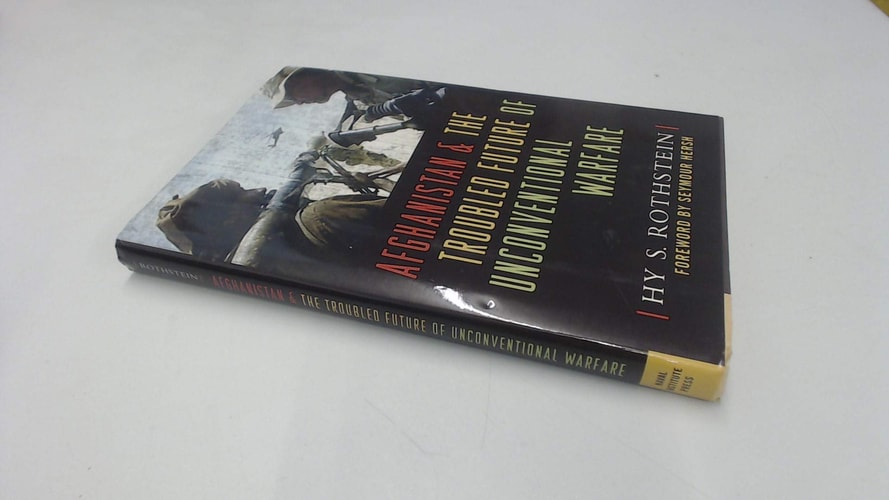
Afghanistan and the Troubled Future of Unconventional Warfare
0
0
As an Amazon Associate and affiliate partner, Menrva Books earns from qualifying purchases. Learn more
Author Description
A Naval Postgraduate School professor and former career Special Forces officer looks at why the U.S. military cannot conduct unconventional warfare despite a significant effort to create and maintain such a capability. In his examination of Operation Enduring Freedom, Hy Rothstein maintains that although the operation in Afghanistan appeared to have been a masterpiece of military creativity, the United States executed its impressive display of power in a totally conventional manner--despite repeated public statements by Secretary of Defense Rumsfeld that terrorists must be fought with unconventional capabilities. Arguing that the initial phase of the war was appropriately conventional given the conventional disposition of the enemy, the author suggests that once the Taliban fell the war became increasingly unconventional, yet the U.S. response became more conventional. This book presents an authoritative overview of the current American way of war and addresses the specific causes of the "conventionalization" of U.S. Special Forces, using the war in Afghanistan as a case study. Drawing a distinction between special operations and unconventional warfare (the use of Special Forces does not automatically make the fighting unconventional), Rothstein questions the ability of U.S. forces to effectively defeat irregular threats and suggests ways to regain lost unconventional warfare capacity.
Menrva's Summary
THE THESIS
The United States military possesses a significant, yet ultimately ineffective, capability for unconventional warfare. Hy S. Rothstein, a professor at the Naval Postgraduate School and former Special Forces officer, argues that despite efforts to build and maintain such a capacity, the U.S. military has failed to conduct unconventional warfare effectively. Using Operation Enduring Freedom in Afghanistan as a central case study, Rothstein details how the initial phase of the war, while appearing innovative, was executed in a conventional manner. He posits that as the conflict evolved into a more unconventional struggle after the fall of the Taliban, the U.S. response paradoxically became more conventional, highlighting a systemic issue within American military strategy.
THE SCOPE MAP
- Analysis of the U.S. military's efforts to create and maintain unconventional warfare capabilities.
- Examination of Operation Enduring Freedom in Afghanistan as a case study.
- Critique of the 'conventionalization' of U.S. Special Forces.
- Distinction between special operations and unconventional warfare.
- Assessment of the U.S. ability to defeat irregular threats.
- Identification of specific causes for the conventional approach to warfare.
- Suggestions for regaining lost unconventional warfare capacity.
THE AUTHORITY PERSPECTIVE
This book presents an authoritative overview of the current American way of war, drawing on the author's extensive experience. Rothstein's analysis of the war in Afghanistan serves as a critical lens through which to examine the effectiveness of U.S. Special Forces in unconventional conflicts. The work is noted for its clear distinction between special operations and true unconventional warfare, challenging common assumptions about military capabilities. It offers a considered perspective on the challenges facing modern militaries in confronting irregular threats and proposes pathways for improvement.
Page Count:
218
Publication Date:
2006-01-01
Publisher:
Naval Institute Press
ISBN-10:
159114745X
ISBN-13:
9781591147459
History
Non-Fiction
Politics
Military History
Community Tags
Similar Books