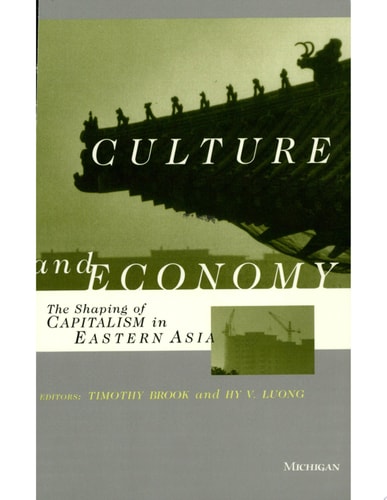
Culture and Economy: The Shaping of Capitalism in Eastern Asia
0
0
As an Amazon Associate and affiliate partner, Menrva Books earns from qualifying purchases. Learn more
Author Description
In recent years, most of the economies of Eastern Asia have been absorbed into global capitalism. Capitalism has transformed these economies, but the process has not been one-way. The cultures of Eastern Asia have in turn shaped how capitalism organizes labor, capital, and markets in ways that could not have been anticipated even ten years ago. On the basis of rich empirical analyses of East and Southeast Asia, and with theoretical insights from different approaches in the social sciences, Culture and Economy addresses these issues in both macroscopic and microscopic terms. Specific topics discussed range from the use and reinvention of Confucian and Islamic legacies in South Korea and Malaysia to promote a particular vision of the economy, to the role of family- and network-structured firms and the reliance on trust-based personal networks in Southeast Asia, to the cultures of labor and management in Chinese village enterprises and Vietnamese ceramics firms, as well as in South Korean export processing zones and the current Chinese labor market. These careful case studies suggest that it is inevitable that Eastern Asia will shape, even remake, capitalism into a system of production and consumption beyond its original definition. Timothy Brook is Professor of History, Stanford University. Hy V. Luong is Professor of Anthropology, University of Toronto.
Menrva's Summary
THE THESIS
Capitalism in Eastern Asia is not a monolithic entity but a dynamic system shaped by local cultures. The book explores how the economies of Eastern Asia have been integrated into global capitalism, but crucially, how these cultures have, in turn, influenced the organization of labor, capital, and markets. Through rich empirical analyses and theoretical insights, it examines the interplay between traditional legacies like Confucianism and Islam and modern economic practices, as well as the role of family structures, trust-based networks, and specific labor cultures in shaping capitalist development.
THE SCOPE MAP
- Macroscopic and microscopic analyses of capitalism in East and Southeast Asia.
- Case studies on the use of Confucian and Islamic legacies in South Korea and Malaysia.
- Analysis of family
- and network-structured firms and trust-based personal networks in Southeast Asia.
- Examination of labor and management cultures in Chinese village enterprises and Vietnamese ceramics firms.
- Exploration of labor practices in South Korean export processing zones and the current Chinese labor market.
- Discussion on how Eastern Asia is reshaping capitalism beyond its original definition.
THE AUTHORITY PERSPECTIVE
This collection of essays offers a nuanced perspective on the integration of Eastern Asian economies into global capitalism, highlighting the reciprocal influence between economic forces and local cultures. The empirical analyses provide detailed insights into how traditional values and social structures are being adapted and reinvented within capitalist frameworks. The book suggests that this ongoing interaction will inevitably lead to a redefinition of capitalism itself, reflecting the unique contributions of Eastern Asian societies. The authors, distinguished scholars in anthropology and history, bring a rigorous academic approach to understanding these complex transformations.
Page Count:
301
Publication Date:
1999-01-22
Publisher:
University of Michigan Press
ISBN-10:
0472085980
ISBN-13:
9780472085989
History
Non-Fiction
Business
Economics
Sociology
Asian Studies
Community Tags
Similar Books