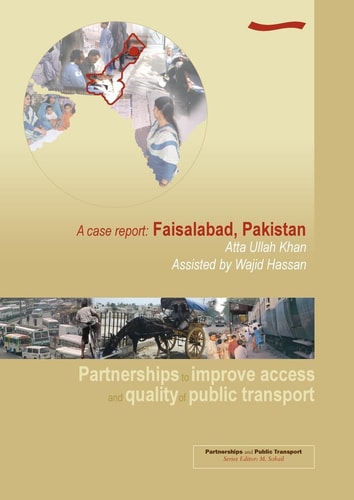
Partnerships to Improve Access and Quality of Public Transport: A Case Report: Faisalabad, Pakistan
0
0
As an Amazon Associate and affiliate partner, Menrva Books earns from qualifying purchases. Learn more
Author Description
This book presents findings from project R7786 Partnerships to improve access and quality of urban public transport for the urban poor carried out by the authors as part of the Knowledge and Research (KaR) programme of the Infrastructure and Urban Development Department, Department for International Development (DFID) of the British Government. The purpose of the project was to identify, explore, and document critical issues in the provision of transport services for and in low-income settlements in developing countries. The identified issues can be used at policy and operational levels to provide better transport services to low-income communities in urban areas. In the research methodology, a sustainable livelihoods framework was used to set the research framework. Faisalabad has 1,977,246 residents at the time of the most recent census in 1998, and it is likely that the population is now well in excess of 2 million. The traffic growth rate was 4.25 per cent in 1991, and that growth rate is likely to be maintained. Public transport availability varies strongly according to the nature of the community, but has not grown at the same rate as the work force. 60 per cent of the city's population live in 'colonies', which are planned developments recognised and accepted by the council. The remainder live in 'Katchi abadies' (houses developed in an unplanned manner and illegally occupied by squatters) or slums consisting of poor people who have moved to the edge of the city in the hope of finding work or education.
Menrva's Summary
THE THESIS
This report investigates critical issues in urban public transport provision for low-income communities in developing countries, using Faisalabad, Pakistan, as a case study. The research, conducted under the Knowledge and Research (KaR) programme of DFID, employed a sustainable livelihoods framework to analyze the challenges faced by residents in accessing and utilizing public transport. It specifically addresses the disparity in transport availability relative to workforce growth and population increase in Faisalabad, a city with a significant portion of its population residing in unplanned settlements or slums. The findings aim to inform policy and operational strategies for improving transport services for the urban poor.
THE SCOPE MAP
- Findings from project R7786 on improving access and quality of urban public transport.
- Focus on the urban poor in developing countries.
- Research methodology utilizing a sustainable livelihoods framework.
- Analysis of transport provision in low-income settlements.
- Case study of Faisalabad, Pakistan, including its population and traffic growth rates.
- Examination of public transport availability in relation to community type and workforce growth.
- Identification of critical issues for policy and operational levels.
THE AUTHORITY PERSPECTIVE
This report details findings from a specific research project aimed at improving public transport for the urban poor, using Faisalabad as a detailed case study. The methodology employed, the sustainable livelihoods framework, suggests a structured approach to understanding the complex interplay of factors affecting transport access. The focus on policy and operational implications indicates a practical application for urban planners and development agencies. The detailed demographic and traffic data for Faisalabad provides a concrete foundation for the analysis.
Page Count:
80
Publication Date:
2003-01-01
Publisher:
Water, Engineering and Development Centre, Loughborough University
ISBN-10:
1843800381
ISBN-13:
9781843800385
Non-Fiction
Transportation
Case Study
Pakistan
urban planning
Community Tags
Similar Books